Word
bleak
US/ˈbɫik/
UK/blˈiːk/
Definition
adj. describing a situation that is cold, empty, and without hope. You use it for bad weather or a gloomy future.
adj. characterized by a lack of warmth, comfort, or hope; dreary and desolate.
Examples
“The winter landscape looked cold and bleak.”
“The report paints a bleak picture of the economy.”
“The bleak reality of the situation forced them to reconsider their ambitious plans.”
Examples
simple
“The winter landscape looked cold and bleak.”
contextual
“The report paints a bleak picture of the economy.”
complex
“The bleak reality of the situation forced them to reconsider their ambitious plans.”
Real-World Examples
“During the interwar period, many intellectuals held a bleak assessment of humanity's future, grappling with the profound societal trauma left by the Great War and the rise of totalitarian ideologies.” “The number of young people with no close friends has risen fivefold since 2014 as a result of growing up in a “bleak world” dominated by austerity, the pandemic and social media.” “John Ratcliffe, the C.I.A. director, made a secretive visit to Moscow this week to privately share his bleak assessment of the state of the Russian war against Ukraine, and to urge the Russians to cut a deal before their military and economic situation gets worse, current and former officials said.” “If we won’t, or can’t, then higher education will have a bleak future.” Etymology
From Middle English bleke (also bleche, whence the English doublet bleach (“pale, bleak”)), and bleike (due to Old Norse), and earlier Middle English blak, blac (“pale, wan”), from Old English blǣc, blǣċ, blāc (“bleak, pale, pallid”) and Old Norse bleikr (“pale, whitish”), all from Proto-Germanic *blaikaz (“pale, shining”). Cognate with Dutch bleek (“pale, wan, pallid”), Low German blek (“pale”), German bleich (“pale, wan, sallow”), Danish bleg (“pale”), Swedish blek (“pale, pallid”), Norwegian Bokmål bleik, blek (“pale”), Norwegian Nynorsk bleik (“pale”), Faroese bleikur (“pale”), Icelandic bleikur (“pale, pink”).
From Middle English bleke (“small river fish, bleak, blay”), perhaps an alteration (due to Old English blǣc (“bright”) or Old Norse bleikja) of Old English blǣġe (“bleak, blay, gudgeon”); or perhaps from a diminutive of Middle English *bleye (“blay”), equivalent to blay + -ock or blay + -kin. See blay.
Etymology adapted from Wiktionary, available under CC BY-SA 4.0.
In Literature
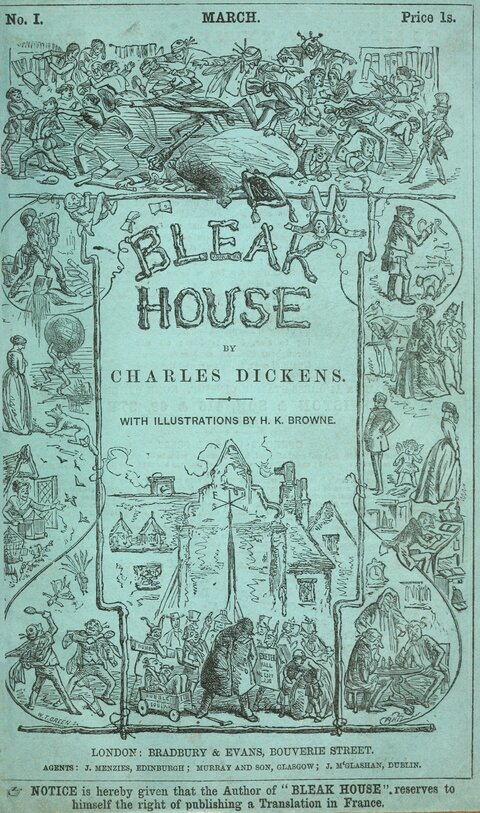
Cover: Public domain, via Wikimedia Commons — Phiz.
Bleak House · 1853-01-01 · Detective fiction
- Author:
- Charles Dickens
Charles Dickens uses this adjective to name the home of Mr. Jarndyce, reflecting the gloomy and hopeless atmosphere created by a never-ending legal battle. The story follows Esther Summerson as she becomes entangled in a complex inheritance case that ruins the lives of almost everyone involved. Through this setting, the author critiques the cold, inefficient British judicial system of the 19th century.
- Exam level
- CambridgeCambridgeCambridge English QualificationsThe exam suite from Cambridge University Press & Assessment, from A1 Movers up to C2 Proficiency. The benchmark names double as CEFR labels.B2 FirstIELTSIELTSInternational English Language Testing SystemThe 0–9 band test co-owned by the British Council, IDP, and Cambridge. Used for university entry, work, and migration.5.5–6.5TOEFL iBTTOEFL iBTTest of English as a Foreign Language, Internet-Based TestETS's academic English test, the standard route for US university admissions. Scored 0–120, with a 1–6 scale since 2026.1–6 scale: 4.0–4.572–94TOEICTOEICTest of English for International CommunicationETS's workplace English test, big in Japan and Korea. Listening & Reading scores 10–990 and tops out at C1.785–944
- Frequency
- Frequent
- Level
- B2 · Upper Intermediate
- Updated
- アルファベット
- 読み方の一覧 →
QR code
englishreference.com/q/bleak