Word
charade
Phoneticscha·rade, stress on the second syllable
US/ʃɝˈeɪd/
UK/ʃɐɹˈɑːd/
Definitions
01a deception or pretence
B2 · Upper Intermediate Countable noun
n. a situation where people pretend something is true or serious, even though everyone knows it is a lie.
n. an absurd or hollow pretence; a deceptive act that is often transparent or obviously false.
“The meeting was a complete charade because the decision had already been made.”
“The diplomatic negotiations were dismissed as a charade by critics who argued that both sides had already committed to military action.”
02the game
B1 · Intermediate Plural noun
n. a game where one player acts out a word or phrase without speaking, and the others try to guess it.
n. a parlour game in which players pantomime the individual syllables of a word or phrase for others to identify.
“We spent the evening playing charades and laughing at my brother's bad acting.”
“During the holiday party, the family gathered in the living room for a competitive round of charades.”
Usage
Usually used in the plural form 'charades' when referring to the game itself.
Synonyms
03a riddle
C2 · Proficiency Countable noun Theater Archaic · Literary
n. an old type of word puzzle where clues are given for each part of a word.
n. a genre of riddle where clues are provided for each syllable of a word followed by a clue for the whole.
Español:charada
“The Victorian book contained several complex charades for the readers to solve.”
“The author included a clever charade within the text, challenging the reader to decipher the hidden name through a series of puns.”
04to pretend or gesture
C1 · Advanced Literary
v. to act something out or pretend to do something.
v. to perform or act out in the manner of a charade; to engage in a pretence.
“He charaded his way through the interview, hoping they wouldn't notice his lack of experience.”
“She charaded her indifference with such skill that even her closest friends were convinced she no longer cared about the outcome.”
Real-World Examples
“Days when my sister would pull me aside and insist the whole setup was a charade: the singing and the pancakes.” Etymology
From French charade, charrade (“prattle, idle conversation; a kind of riddle”), probably from Occitan charrada (“conversation; chatter”), from charrar (“to chat; to chatter”) + -ada. As a round of the game, originally a clipping of acting charade but now usually understood and formed as a back-formation from charades.
Etymology adapted from Wiktionary, available under CC BY-SA 4.0.
The word in film
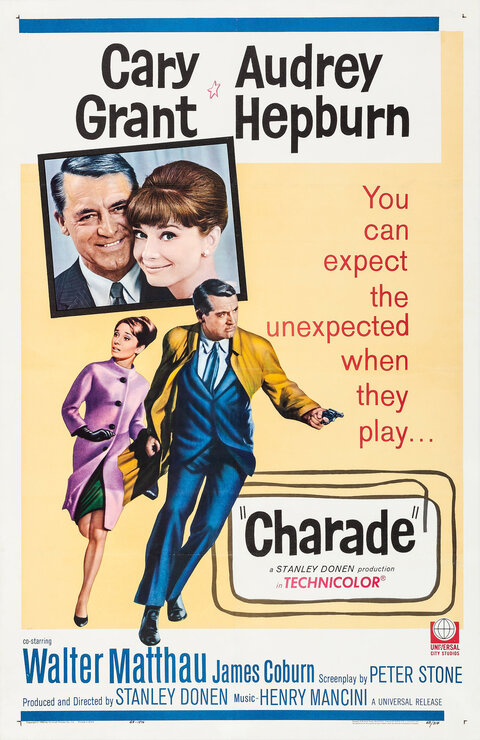
Poster: Public domain, via Wikimedia Commons.
Charade · 1963 · Comedy
- Directed by:
- Stanley Donen
- Starring:
- Audrey Hepburn, Cary Grant, James Coburn
Audrey Hepburn stars in this 1963 romantic thriller about a woman whose life becomes a dangerous game of lies after her husband is murdered. The title describes the way several characters pretend to be people they are not to hide their true identities.
Domain
- Exam level
- CambridgeCambridgeCambridge English QualificationsThe exam suite from Cambridge University Press & Assessment, from A1 Movers up to C2 Proficiency. The benchmark names double as CEFR labels.C1 AdvancedIELTSIELTSInternational English Language Testing SystemThe 0–9 band test co-owned by the British Council, IDP, and Cambridge. Used for university entry, work, and migration.7.0–8.0TOEFL iBTTOEFL iBTTest of English as a Foreign Language, Internet-Based TestETS's academic English test, the standard route for US university admissions. Scored 0–120, with a 1–6 scale since 2026.1–6 scale: 5.0–5.595–113TOEICTOEICTest of English for International CommunicationETS's workplace English test, big in Japan and Korea. Listening & Reading scores 10–990 and tops out at C1.945–990
- Frequency
- Occasional
- Level
- C1 · Advanced
- Updated
- アルファベット
- 読み方の一覧 →
QR code
englishreference.com/q/charade
Traducciones: Kaikki.org (Wiktionary), CC BY-SA 4.0