Word
fame
US/ˈfeɪm/
UK/fˈeɪm/
Definitions
01being well-known
B1 · Intermediate Uncountable noun
n. the state of being famous or known by many people.
n. the condition of being known or talked about by many people, especially on account of notable achievements.
“The young actor achieved worldwide fame after his first movie became a hit.”
“Despite her sudden rise to international fame, the scientist remained dedicated to her laboratory work and avoided the public spotlight.”
02reputation
C1 · Advanced Uncountable noun Literary
n. the opinion that people have about someone or something.
n. the character or reputation attributed to a person or thing by the public.
“The knight's fame for bravery spread throughout the kingdom.”
“His fame as a fair and just ruler preceded him, ensuring a warm welcome from the local governors.”
Synonyms
03to make famous
C2 · Proficiency Archaic · Literary
v. to make someone or something famous.
v. to confer fame upon someone or to make something widely known. Transitive — requires a direct object.
“The poet's verses served to fame the heroes of the revolution.”
“The explorer was famed throughout the continent for his daring expeditions into the uncharted interior.”
Synonyms
Collocations
Common phrases and expressions where native English speakers use the word “fame” in context.
Verb
01. achieve international fame
“The young pianist achieved international fame after winning the prestigious competition.”
verb + adj + noun
02. find fame
“She found fame late in life after her first novel became a surprise bestseller.”
verb + noun
03. seek fame
“Many people move to Hollywood to seek fame and fortune, but few actually succeed.”
verb + noun
Adjective
04. instant fame
“Social media can provide instant fame, but it often disappears just as quickly.”
adj + noun
05. lasting fame
“The scientist's discoveries earned him lasting fame in the field of physics.”
adj + noun
Noun
06. claim to fame
“The town's only claim to fame is that a famous poet was born there.”
noun + prep + noun
07. hall of fame
“The legendary player was finally inducted into the basketball hall of fame.”
noun + of + noun
Preposition
08. rise to fame
“Her rapid rise to fame surprised everyone in the music industry.”
prep + noun
Real-World Examples
“Raised in Tennessee, she rose to fame in the late 1960s with hits that bridged country and pop music.” “She addresses that relative lack of financial success and fame uproariously on the new album.” Etymology
From Middle English fame, from Old French fame (“celebrity, renown”), itself borrowed from Latin fāma (“talk, rumor, report, reputation”), from Proto-Indo-European bʰéh₂-meh₂, from bʰeh₂- (“to speak, say, tell”). Cognate with Ancient Greek φήμη (phḗmē, “talk”). Related also to Latin for (“speak, say”, verb), Old English bōian (“to boast”), Old English bēn (“prayer, request”), Old English bannan (“to summon, command, proclaim”). More at ban. Displaced native Old English hlīsa.
Etymology adapted from Wiktionary, available under CC BY-SA 4.0.
Word family
NOUN
ADJECTIVE
ADVERB
Idioms
In Music
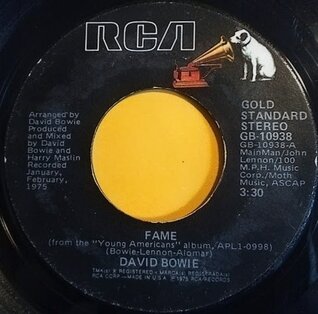
Cover shown under fair use for identification and commentary.
Fame · 1975 · Funk
- Artist:
- David Bowie
- Album:
- Young Americans
David Bowie’s 1975 funk hit explores the darker side of being a global celebrity. The title uses the word in its most common sense to describe the singer's personal frustration with the pressures and shallow nature of stardom.
- Exam level
- CambridgeCambridgeCambridge English QualificationsThe exam suite from Cambridge University Press & Assessment, from A1 Movers up to C2 Proficiency. The benchmark names double as CEFR labels.B2 FirstIELTSIELTSInternational English Language Testing SystemThe 0–9 band test co-owned by the British Council, IDP, and Cambridge. Used for university entry, work, and migration.5.5–6.5TOEFL iBTTOEFL iBTTest of English as a Foreign Language, Internet-Based TestETS's academic English test, the standard route for US university admissions. Scored 0–120, with a 1–6 scale since 2026.1–6 scale: 4.0–4.572–94TOEICTOEICTest of English for International CommunicationETS's workplace English test, big in Japan and Korea. Listening & Reading scores 10–990 and tops out at C1.785–944
- Frequency
- Common
- Level
- B2 · Upper IntermediateOxford
- Updated
- アルファベット
- 読み方の一覧 →
QR code
englishreference.com/q/fame