Word
heretic
US/ˈhɛɹətɪk/
UK/hˈɛɹətˌɪk/
Definition
n. a person who has different religious beliefs from the ones their group officially accepts. In the past, this was a very serious crime.
n. a person who holds beliefs or opinions contrary to those accepted by a religious group or church. Historically associated with severe punishment or execution.
Examples
“The king declared him a heretic for his new ideas.”
“During the Middle Ages, anyone who questioned the official church teachings was often labeled a heretic.”
“The philosopher was accused of being a heretic because his radical theories about the nature of the soul challenged the established doctrines of the time.”
Examples
simple
“The king declared him a heretic for his new ideas.”
contextual
“During the Middle Ages, anyone who questioned the official church teachings was often labeled a heretic.”
complex
“The philosopher was accused of being a heretic because his radical theories about the nature of the soul challenged the established doctrines of the time.”
Real-World Examples
“Those who held a belief or opinion contrary to the orthodox religions, especially Christian doctrine, were labelled heretics and forced to wear the distinctive hat.” “The heretic, however, is now exposed to public intimidation and abuse on a scale inconceivable before the invention of the internet.” “It is not often, in liberal north London, that you come face to face with a heretic, but Rupert Sheldrake has worn that mantle, pretty cheerfully, for 30 years now.” Etymology
From Middle English heretyk, heretike, from Old French eretique, from Medieval Latin or Ecclesiastical Latin haereticus, from Ancient Greek αἱρετικός (hairetikós, “able to choose, factious”), itself from Ancient Greek αἱρέω (hairéō, “I choose”).
Etymology adapted from Wiktionary, available under CC BY-SA 4.0.
In Literature
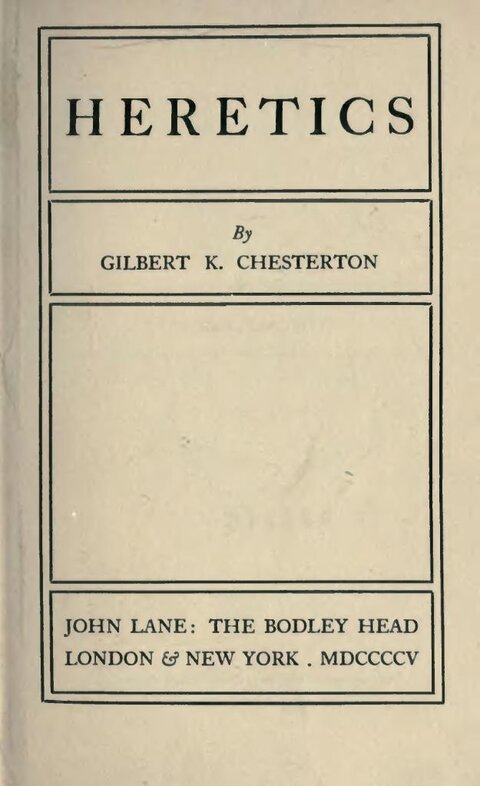
Cover: Public domain, via Wikimedia Commons — G. K. Chesterton.
Heretics · 1905-01-01 · Essay
- Author:
- G. K. Chesterton
G. K. Chesterton’s 1905 collection of essays examines the ideas of prominent contemporary thinkers, such as George Bernard Shaw and H. G. Wells. The author uses the term to describe intellectuals whose modern philosophies deviate from traditional Christian orthodoxy. By challenging these popular secular views, Chesterton frames his subjects as modern-day dissenters against established moral truths.
Domain
Scan code
englishreference.com/q/heretic