Word
hobbit
Phoneticshob·bit
US/ˈhɑbɪt/
UK/hˈɒbɪt/
Definition
n. a small, human-like creature with hairy feet that lives in a hole in the ground. They are famous for being quiet, liking food, and living in stories by J.R.R. Tolkien.
n. a member of an imaginary race of small, human-like beings with hairy feet and a preference for domestic comfort. Originally a literary creation, the term is now used metaphorically to describe someone of small stature or unassuming nature.
Examples
“The hobbit lived in a cozy hole under the hill.”
“In the film, the hobbit must leave his comfortable home to go on a dangerous adventure across the mountains.”
“The author's portrayal of the hobbit as a creature of simple pleasures serves as a deliberate contrast to the grand, often tragic heroism of the taller races in the epic.”
Examples
simple
“The hobbit lived in a cozy hole under the hill.”
contextual
“In the film, the hobbit must leave his comfortable home to go on a dangerous adventure across the mountains.”
complex
“The author's portrayal of the hobbit as a creature of simple pleasures serves as a deliberate contrast to the grand, often tragic heroism of the taller races in the epic.”
Usage
Capitalised in its specific literary sense; often lowercase when used as a general descriptive term in modern slang.
Real-World Examples
“Lord of the Rings actors including Elijah Wood have expressed their support for the project of an Italian man who lives as a hobbit and is building his personal “shire” from JRR Tolkien’s fictional Middle-earth in Italy.” “Nicolas Gentile, a 37-year-old Italian pastry chef, did not just want to pretend to be a hobbit – he wanted to live like one.” Etymology
Coined in its current sense by J. R. R. Tolkien in the 1930s, featured in the novels The Hobbit and The Lord of the Rings. Jocularly etymologized by him as from a hypothetical Old English *holbytla (literally “hole-builder”), from hol (“hole”) + bytlan (“to build”) + -a (“-er”). Tolkien was possibly influenced by similar terms for house-sprites (probably from Hob, a hypocoristic form of Robert), or an isolated mention of hobbits (with hobgoblins following immediately afterwards) in a list of sprites and bogies from the 19th-century Denham Tracts.
Probably from hoppet, hobbet (“basket”).
Etymology adapted from Wiktionary, available under CC BY-SA 4.0.
In Literature
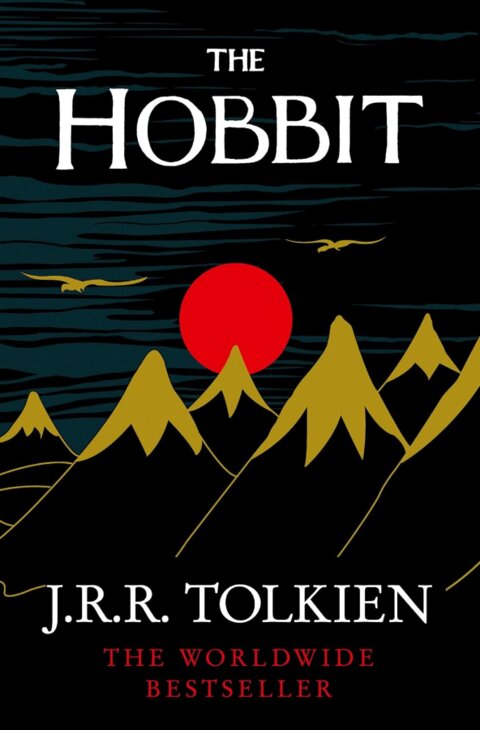
Cover art based on J.R.R. Tolkien illustration.
The Hobbit · 1937-09-21 · Fairy tale, fantasy
- Author:
- J. R. R. Tolkien
J.R.R. Tolkien introduced the world to these gentle, home-loving creatures in his 1937 fantasy classic. The story follows Bilbo Baggins, a quiet protagonist who is forced to leave his comfortable hole in the ground to join a dangerous quest for dragon-guarded treasure. Through Bilbo's journey, the book explores how even the smallest person can display great courage when facing the unknown.
Scan code
englishreference.com/q/hobbit