Word
regret
Phoneticsre·gret, stress on the second syllable
US/ɹəˈɡɹɛt/
UK/ɹɪɡɹˈɛt/
Definitions
01to feel sorry about an action
B1 · Intermediate
v. to feel sad or sorry about something you did, or a situation that happened.
v. to feel sorrow or remorse regarding a past action, event, or omission. Transitive, often taking a gerund or a 'that' clause.
日本語:後悔する※
Español:lamentar
“He deeply regretted shouting at his friend during the argument yesterday.”
“Many retirees admit they regret not travelling more extensively while they still possessed the physical stamina to do so.”
Pitfall
I regret to tell you that I lied.
I regret telling you that I lied.
Use 'regret' + -ing to talk about the past. Use 'regret to' + verb to give bad news in the present.
02to formally give bad news
B2 · Upper Intermediate Formal
v. a polite way to say you are sorry to tell someone something disappointing.
v. used in formal correspondence to introduce disappointing information or a refusal. Typically followed by a to-infinitive.
“We regret to inform you that your application was not successful.”
“The airline regrets to announce that the flight to Paris has been cancelled due to technical difficulties with the aircraft.”
Synonyms
03the feeling of sadness
B1 · Intermediate Uncountable noun
n. the sad feeling you have when you wish you had done something differently.
n. the emotional state of remorse or dissatisfaction directed toward a past event. Both countable and uncountable.
日本語:後悔※
“She left the party with a sense of regret after her awkward conversation.”
“The protagonist's life was defined by a profound regret over a single decision made in his youth.”
Antonyms
04declining an invitation
C1 · Advanced Plural noun Formal
n. a formal message saying that you cannot go to an event.
n. a formal notification that one is unable to accept an invitation. Often used in the plural form 'regrets'.
“Please send your regrets by Friday if you cannot attend the wedding.”
“The CEO sent her regrets, explaining that a prior board commitment prevented her from attending the gala.”
Antonyms
Collocations
Common phrases and expressions where native English speakers use the word “regret” in context.
Noun
01. deep sense of regret
“The retiring teacher looked back on her long career with a deep sense of regret.”
adj + noun + of + noun
02. express regret for the mistake
“The airline issued a statement to express regret for the mistake.”
verb + noun + prep + noun
03. pang of regret
“As he watched the ship sail away, he felt a sudden pang of regret.”
noun + of + noun
Preposition
04. with regret
“It is with regret that we announce the cancellation of tonight's performance.”
prep + noun
Adverb
05. bitterly regret that
“She bitterly regretted that she had never told her father how much she loved him.”
adv + verb + that-clause
06. deeply regret the decision
“The manager said he deeply regretted the decision to close the local branch.”
adv + verb + noun
Real-World Examples
“The Ulez has been the toughest fight of my political life, but I have no regrets.” “She wore black one day and "really regretted it," she said.” Etymology
From Middle English regretten, regreten, from Old French regreter, regrater (“to lament”), from re- (intensive prefix) + greter, grater (“to weep”), from Frankish grātan (“to weep, mourn, lament”), from Proto-Germanic grētaną (“to weep”), from Proto-Indo-European ǵʰreh₁d- (“to sound”); and Frankish greutan (“to cry, weep”), from Proto-Germanic greutaną (“to weep, cry”), from Proto-Indo-European gʰrewd- (“to weep, be sad”), equivalent to re- + greet. Cognate with Old High German grāzan (“to cry”), Old English grǣtan (“to weep, greet”), Old English grēotan (“to weep, lament”), Old Norse gráta (“to weep, groan”), Gothic 𐌲𐍂𐌴𐍄𐌰𐌽 (grētan, “to weep”). More at greet.
Etymology adapted from Wiktionary, available under CC BY-SA 4.0.
Word family
VERB
ADJECTIVE
Grammar
In Music
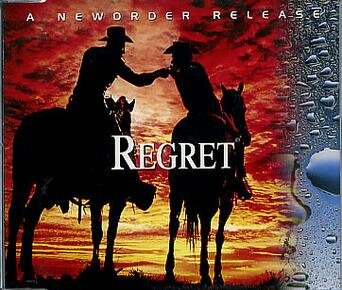
Cover shown under fair use for identification and commentary.
Regret · 1993 · Alternative rock
- Artist:
- New Order
- Album:
- Republic
New Order released this alternative rock track in 1993 as the lead single from their album Republic. The title refers to the heavy feeling of sadness one experiences when looking back at past mistakes. It explores the noun form of the word to describe a sense of loss and missed opportunities.
- Exam level
- CambridgeCambridgeCambridge English QualificationsThe exam suite from Cambridge University Press & Assessment, from A1 Movers up to C2 Proficiency. The benchmark names double as CEFR labels.B2 FirstIELTSIELTSInternational English Language Testing SystemThe 0–9 band test co-owned by the British Council, IDP, and Cambridge. Used for university entry, work, and migration.5.5–6.5TOEFL iBTTOEFL iBTTest of English as a Foreign Language, Internet-Based TestETS's academic English test, the standard route for US university admissions. Scored 0–120, with a 1–6 scale since 2026.1–6 scale: 4.0–4.572–94TOEICTOEICTest of English for International CommunicationETS's workplace English test, big in Japan and Korea. Listening & Reading scores 10–990 and tops out at C1.785–944
- Frequency
- Common
- Level
- B2 · Upper IntermediateOxford
- Updated
- アルファベット
- 読み方の一覧 →
QR code
englishreference.com/q/regret
※ 機械で選んだ訳語です。ネイティブスピーカーによる確認はまだです。
「日本語」 data: JMdict (EDRDG), CC BY-SA 4.0
Traducciones: Kaikki.org (Wiktionary), CC BY-SA 4.0