Word
robot
Definition
n. a machine that can do tasks by itself, often ones that are difficult or repetitive for people. It is usually controlled by a computer.
n. a machine capable of carrying out a complex series of actions automatically, especially one programmable by a computer.
Examples
“A robot builds cars in the factory.”
“The new cleaning robot vacuums the floors while the family is out.”
“A surgical robot can perform complex procedures with a level of precision that a human surgeon cannot match.”
Examples
simple
“A robot builds cars in the factory.”
contextual
“The new cleaning robot vacuums the floors while the family is out.”
complex
“A surgical robot can perform complex procedures with a level of precision that a human surgeon cannot match.”
Collocations
Common phrases and expressions where native English speakers use the word “robot” in context.
Verb
01. deploy robot
“The military plans to deploy a robot for bomb disposal missions.”
verb + noun
02. operate robot
“The technician was trained to operate the robot via a remote control.”
verb + noun
03. program robot
“Students learn how to program a robot to navigate through a simple maze.”
verb + noun
04. robot malfunctions
“Production stopped briefly when the welding robot malfunctioned.”
noun + verb
Adjective
05. humanoid robot
“Researchers are developing a humanoid robot that can recognize facial expressions.”
adj + noun
06. autonomous robot
“The warehouse uses an autonomous robot to move heavy pallets without human help.”
adj + noun
07. industrial robot
“The factory installed a new industrial robot to speed up the assembly line.”
adj + noun
Noun
08. army of robots
“An army of robots is used to sort thousands of packages every hour.”
noun + prep + noun
09. generation of robots
“The next generation of robots will be able to learn from their own mistakes.”
noun + prep + noun
10. build and design robots
“The engineering course teaches students how to build and design robots.”
11. controlled by a robot
“The entire manufacturing process is now controlled by a robot.”
12. replace humans with robots
“Many companies are looking to replace humans with robots for dangerous jobs.”
Real-World Examples
“A two-legged delivery robot has taken to the streets of Barnsley for a "European-first" trial.” “Robots are increasingly taking a key role in combat and replacing human infantry.” “This year will be filled with robots that can fold your laundry, pick up objects and climb stairs, fridges that you can command to open by voice, laptops with screens that can follow you around the room on motorised hinges and the reimagining of the BlackBerry phone.” “Amazon said it has made a “fundamental leap forward in robotics” after developing a robot with a sense of touch that will be capable of grabbing about three-quarters of the items in its vast warehouses.” Etymology
From Czech robot, taken directly into German as Robot before it moved on into English. The term had been coined by Karel Čapek for his 1920 play R.U.R., where it denoted factory-made artificial labourers; Čapek credited his brother Josef, a painter and writer, with supplying the word itself.
The underlying root is Common Slavic robota, “forced labour, corvée”, a concept whose historical echoes the mechanical figures were meant to amplify. The modern sense arrived with the play; the spelling, via German, arrived a year later.
The word arrived in English from Prague in 1920, carried by Karel Čapek’s play R.U.R. Čapek had asked his brother Josef for a convincing label for factory-produced artificial workers who would later revolt and murder their makers; Josef suggested robot, lifted from Czech robota, “forced labour”, itself from Old Czech robota signifying corvée owed to a feudal lord.
That Old Czech form descends from Proto-Slavic orbota, built on orbъ “slave, servant”, which continues a Proto-Balto-Slavic root árbas. The lineage reaches back to Proto-Indo-European h₃órbhos, the same source that gives German Arbeit and, in another branch, English orphan; the Slavic line kept the -t- suffix after the stem while Greek took a different route.
Within a decade of the play the term had crossed into English intact, and the metal labourers of Čapek’s theatre acquired a generic name. Polish robotnik and Russian работник, both simply meaning “worker”, share the root but were never the conduit; the borrowing happened directly from Czech stage directions to international vocabulary, with no intermediate stop.
2008, Randall Munroe releases the ROBOT9000 script to silence repeated chatter. A 4chan board adopts the filter, takes the abbreviation /r9k/, and starts to fill with anonymised confessions of social fatigue. The script’s name shortens naturally to r9k, the numeral echoing the original tag.
Whether the second, human sense — “robot” as someone affectless, moving through normal exchanges with the blank competence of circuitry — drifted in later or was already understood among the board’s first users is a question that bored moderators have left open.
Etymology adapted from Wiktionary, available under CC BY-SA 4.0.
Word family
NOUN
ADJECTIVE
Related words
In Literature
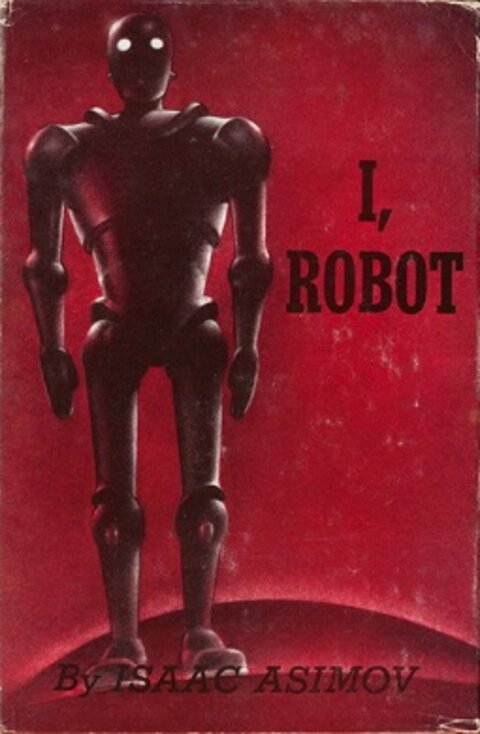
Cover shown under fair use for identification and commentary.
I, Robot · 1950-12-02 · Science fiction
- Author:
- Isaac Asimov
Isaac Asimov’s 1950 collection explores the complex relationship between humanity and the machines they create to serve them. Through a series of connected stories, the author introduces the Three Laws of Robotics, which govern how a robot must behave to ensure human safety. These narratives examine the logical challenges and ethical dilemmas that arise when artificial beings perform tasks in an increasingly automated world.
Domains
- Exam level
- CambridgeCambridgeCambridge English QualificationsThe exam suite from Cambridge University Press & Assessment, from A1 Movers up to C2 Proficiency. The benchmark names double as CEFR labels.B1 PreliminaryIELTSIELTSInternational English Language Testing SystemThe 0–9 band test co-owned by the British Council, IDP, and Cambridge. Used for university entry, work, and migration.4.0–5.0TOEFL iBTTOEFL iBTTest of English as a Foreign Language, Internet-Based TestETS's academic English test, the standard route for US university admissions. Scored 0–120, with a 1–6 scale since 2026.1–6 scale: 3.0–3.544–71TOEICTOEICTest of English for International CommunicationETS's workplace English test, big in Japan and Korea. Listening & Reading scores 10–990 and tops out at C1.550–784
- Frequency
- Common
- Level
- B1 · IntermediateOxford
- Updated
- アルファベット
- 読み方の一覧 →
QR code
englishreference.com/q/robot
※ 機械で選んだ訳語です。ネイティブスピーカーによる確認はまだです。
「日本語」「カタカナ語」 data: JMdict (EDRDG), CC BY-SA 4.0
‘외래어’ data: 한국어기초사전 (국립국어원), CC BY-SA 2.0 KR