Word
samurai
Phoneticssamu·rai
US/ˈsæmɝˌaɪ/
UK/sˈæmjʊɹˌaɪ/
Definition
n. a member of a powerful military class in old Japan. These warriors were famous for their skill with swords and their strict rules of behavior.
n. a member of the hereditary warrior caste in feudal Japan, active from the 12th century until the late 19th century. Governed by the bushido code, which emphasized honor, discipline, and loyalty.
Examples
“The samurai carried two swords as a sign of his rank.”
“Historians study the armor and weapons used by the samurai to understand medieval Japanese warfare.”
“The abolition of the feudal system during the Meiji Restoration effectively ended the traditional role of the samurai, forcing many to transition into administrative or business careers.”
Examples
simple
“The samurai carried two swords as a sign of his rank.”
contextual
“Historians study the armor and weapons used by the samurai to understand medieval Japanese warfare.”
complex
“The abolition of the feudal system during the Meiji Restoration effectively ended the traditional role of the samurai, forcing many to transition into administrative or business careers.”
Usage
The plural form can be either 'samurai' or 'samurais', though the former is more common in historical contexts.
Real-World Examples
“The true story of the samurai is one of evolution and adaption, from their beginning as medieval mercenaries to their later status as gentrified bureaucrats and patrons of the arts.” “The samurai, Japan’s celebrated lineage of warriors, emerged in the Heian period (794-1185), when the rise of their status enabled them to mingle with the refined nobility living in the then-capital of Heian-kyō (Kyoto).” “Jesuit missionaries in the area attempted to have Adams executed on charges of piracy, yet he evaded that outcome and ultimately became Japan's first documented western samurai, establishing a connection between the enigmatic archipelago and his homeland, which he would never revisit.” “For centuries, the privilege of wearing swords was exclusive to the samurai, with this noble lineage passed down from father to son.” Etymology
Borrowed from Japanese 侍 (samurai).
Root Verb: Derived from saburau (later changing to saburai), the noun originally meant an attendant, servant, or guard who served the nobility.
Early Usage: First recorded in the 8th century (around A.D. 702), the term initially described mid-to-low-ranking administrative servants and imperial guards in the imperial court, rather than elite combatants.
Shift to Warrior: By the late Heian period (794–1185), as provincial landowners and aristocratic families hired armed guards to protect their properties, the word shifted exclusively to mean armed retainers and aristocratic warriors.
Original etymology written by Shinotoshi Nakamura.
The word in film
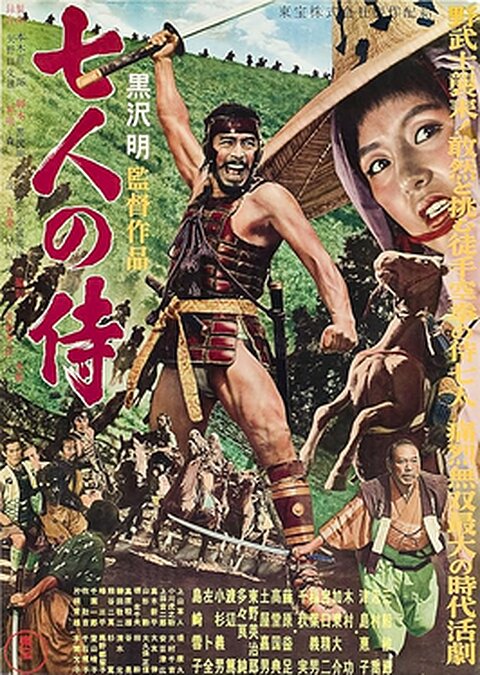
Poster: Public domain, via Wikimedia Commons.
Seven Samurai · 1954 · Action
- Directed by:
- Akira Kurosawa
- Starring:
- Toshirō Mifune, Takashi Shimura, Tatsuya Nakadai
Akira Kurosawa directs this 1954 action epic about a vulnerable farming village that hires seven masterless warriors for protection against marauding bandits. Toshirō Mifune stars among the defenders, embodying the traditional samurai who dedicated their lives to swordsmanship and martial honor in feudal Japan.