Word
sushi
US/ˈsuʃi/
UK/sˈuːʃi/
Definitions
01Japanese rice dish
n. a Japanese food made of small pieces of cold rice with vinegar, often topped with raw fish or wrapped in seaweed.
n. a Japanese dish of vinegared rice, typically served with a garnish of seafood, vegetables, or egg. While often associated with raw fish, the term technically refers to the prepared rice itself.
“We went to a Japanese restaurant and ordered a large platter of sushi to share.”
“The chef demonstrated the precise technique required to shape the sushi rice without crushing the individual grains.”
Usage
Usually uncountable when referring to the cuisine, but can be countable when referring to individual pieces.
Pitfall
I don't like sushi because I don't eat raw fish.
I don't like sashimi because I don't eat raw fish.
Many learners confuse sushi (the rice dish) with sashimi (plain slices of raw fish). Sushi always contains rice, but not all sushi contains raw fish.
02to prepare as sushi
v. to prepare a specific ingredient, like fish or vegetables, in the style of sushi.
v. to prepare or style a food item according to the conventions of sushi preparation. This usage is often found in creative or fusion culinary contexts.
“The chef decided to sushi the local trout for the fusion menu.”
“The restaurant's signature move is to sushi non-traditional ingredients like smoked duck and pickled pear.”
Informal
Teaching tip
This verbal use is quite rare and mostly found in trendy culinary circles or informal food writing.
Etymology
Borrowed from Japanese 寿司(すし) (sushi, “sushi (sour rice)”), ultimately from archaic conjugation 酸(す)し (sushi, “sour, vinegared”) of modern adjective 酸(す)い (sui, “sour, vinegared”).
Etymology adapted from Wiktionary, available under CC BY-SA 4.0.
The word in film
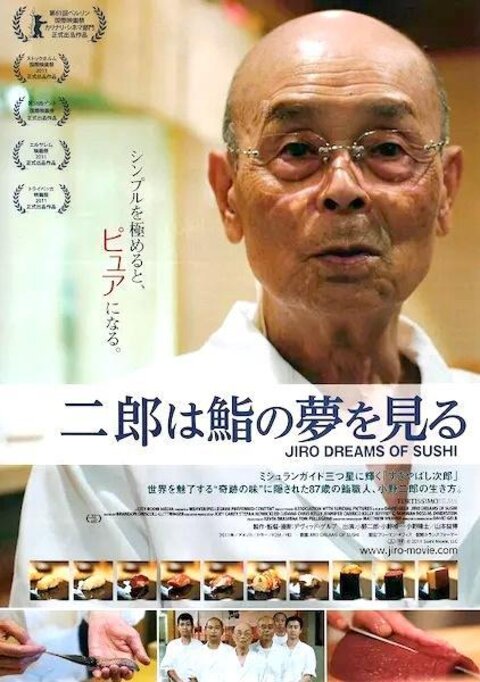
Original artwork: theatrical poster courtesy of Magnolia Pictures.
Jiro Dreams of Sushi · 2011 · Documentary
- Directed by:
- David Gelb
- Starring:
- Jiro Ono, Yoshikazu Ono, Takashi Ono
David Gelb directed this acclaimed 2011 documentary profiling 85-year-old master chef Jiro Ono and his dedicated quest for culinary perfection. The title uses the word in its primary sense as the traditional Japanese dish of vinegared rice topped with raw fish, highlighting the lifelong discipline required to master the craft at Tokyo's famed Sukiyabashi Jiro.
Scan code
englishreference.com/q/sushi