Word
Definition
n. a painful, open sore on the skin or inside the body that is slow to heal. You often hear about them in the stomach or on the mouth.
n. an open sore on an external or internal surface of the body, caused by a break in the skin or mucous membrane that fails to heal. Often associated with infection, inflammation, or underlying systemic conditions.
Examples
“He had a painful ulcer on his tongue.”
“The doctor explained that stress was not the primary cause of his stomach ulcer, but it certainly made the symptoms worse.”
“Chronic venous insufficiency can lead to the development of a leg ulcer, which requires specialized wound care and compression therapy to facilitate proper healing of the tissue.”
Examples
simple
“He had a painful ulcer on his tongue.”
contextual
“The doctor explained that stress was not the primary cause of his stomach ulcer, but it certainly made the symptoms worse.”
complex
“Chronic venous insufficiency can lead to the development of a leg ulcer, which requires specialized wound care and compression therapy to facilitate proper healing of the tissue.”
Usage
Commonly modified by its location, such as 'stomach', 'mouth', or 'peptic'.
Real-World Examples
“Xylazine also causes necrotic skin ulcers, wounds so deep they can make it down to the bone and are difficult to treat.” “This is wildly common: around one in four of us will get a mouth ulcer (also known as an aphthous ulcer or canker sore) at some point, says Dr Lucy Hooper, private GP and co-founder of Coyne Medical in Fulham.” “Some reported that people with mouth ulcers who used SLS-free toothpaste experienced a 70% reduction in ulcers.” “Common mouth ulcers, known as aphthous ulcers or canker sores, can bother us all.” Etymology
From Old French ulcere, from Latin ulcus. Doublet of ulcus.
Etymology adapted from Wiktionary, available under CC BY-SA 4.0.
Word family
NOUN
ADJECTIVE
In Literature
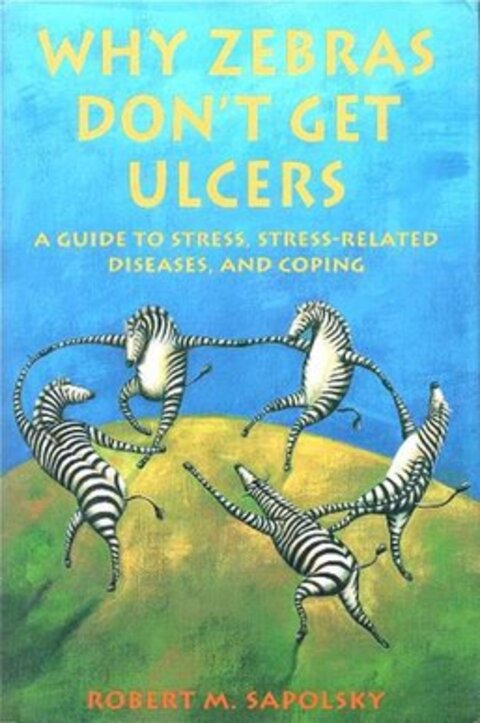
Cover shown under fair use for identification and commentary.
Why Zebras Don't Get Ulcers · 1994-01-01 · Non-fiction
- Author:
- Robert Sapolsky
Why Zebras Don't Get Ulcers is a popular science book about stress. Robert Sapolsky explains why a zebra's brief fright does little harm, while long worry can damage the body and lead to conditions such as an ulcer. The book helps readers see how stress affects their health.
- Exam level
- CambridgeCambridgeCambridge English QualificationsThe exam suite from Cambridge University Press & Assessment, from A1 Movers up to C2 Proficiency. The benchmark names double as CEFR labels.B2 FirstIELTSIELTSInternational English Language Testing SystemThe 0–9 band test co-owned by the British Council, IDP, and Cambridge. Used for university entry, work, and migration.5.5–6.5TOEFL iBTTOEFL iBTTest of English as a Foreign Language, Internet-Based TestETS's academic English test, the standard route for US university admissions. Scored 0–120, with a 1–6 scale since 2026.1–6 scale: 4.0–4.572–94TOEICTOEICTest of English for International CommunicationETS's workplace English test, big in Japan and Korea. Listening & Reading scores 10–990 and tops out at C1.785–944
- Frequency
- Occasional
- Level
- B2 · Upper Intermediate
- Updated
- アルファベット
- 読み方の一覧 →
QR code
englishreference.com/q/ulcer
※ 機械で選んだ訳語です。ネイティブスピーカーによる確認はまだです。
「日本語」 data: JMdict (EDRDG), CC BY-SA 4.0