Word
breakfast
Phoneticsbreak·fast, stress on the first syllable
US/ˈbɹɛkfəst/
UK/bɹˈɛkfəst/
Definitions
01first meal of the day
A1 · Beginner Countable noun
n. the first meal you eat after waking up, usually in the morning.
n. the first meal of the day, typically consumed during the morning hours.
日本語:朝ごはん※
“I usually have a quick breakfast of toast and coffee before I leave for work.”
“Nutritionists often argue that a balanced breakfast provides the necessary glucose to maintain cognitive function throughout a demanding morning schedule.”
02type of food
B1 · Intermediate Countable noun
n. a meal made of foods usually eaten in the morning, like eggs or cereal, even if eaten later.
n. a meal consisting of specific food items traditionally associated with the morning, regardless of the time of consumption.
日本語:朝食※
“The café serves a full English breakfast all day long.”
“The diner specialised in traditional breakfast fare, offering pancakes and smoked bacon well into the evening hours for late-shift workers.”
03post-ceremony meal
B2 · Upper Intermediate Countable noun British English · Formal
n. a special meal served after a formal event like a wedding.
n. a celebratory meal served following a religious or solemn ceremony, most commonly a wedding.
“After the church service, the guests gathered for a wedding breakfast at a nearby hotel.”
“The wedding breakfast was held in the grand ballroom, featuring a three-course menu that reflected the couple's heritage.”
04to eat the morning meal
C1 · Advanced Literary · Formal
v. to eat your first meal of the day.
v. to consume the morning meal; used as an intransitive verb.
Español:desayunar
“The guests breakfasted on the terrace while enjoying the view of the mountains.”
“The travellers breakfasted early at the inn before continuing their journey across the pass.”
Synonyms
Real-World Examples
“Push the boat out at the weekend and have yourself a savoury and satisfying cooked breakfast.” “Research indicates that individuals who forgo breakfast often consume less fiber, vital minerals, and vitamins.” “There’s no good reason you can’t eat a chicken-parmesan hoagie for breakfast.” “Imagine an American breakfast and what comes to mind?” Etymology
Middle English brekefast, modelled on the Old English fæstenbryċe, a compound whose second element supplies the older word for the meal and whose first element explains what one does to it: bryċe is “breaking”, fæsten is “fast”. Thus the daily action of ending the overnight abstention from food.
The Dutch cognate breekvasten keeps the same logic, merely shifting the word order.
Etymology adapted from Wiktionary, available under CC BY-SA 4.0.
Related words
Idioms
01. dog's breakfast
In Literature
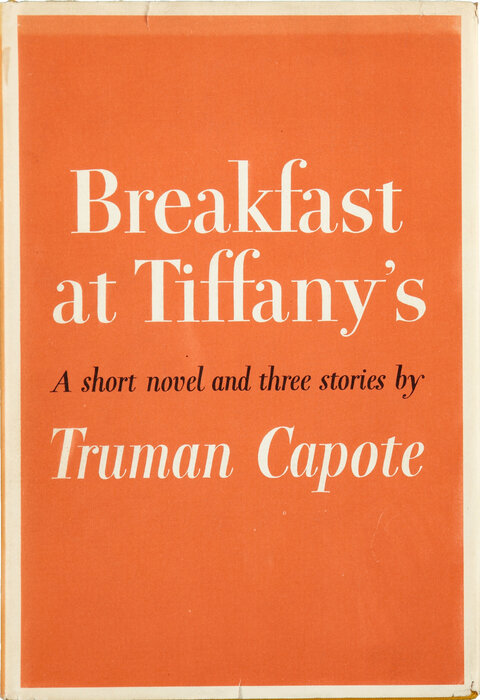
Cover: Public domain, via Wikimedia Commons — Jacket design by Ismar David (1910-1996).
Breakfast at Tiffany's · 1958-01-01 · Drama fiction
- Author:
- Truman Capote
Truman Capote’s 1958 novella introduces Holly Golightly, a socialite who finds comfort standing outside a luxury jewelry store while eating her morning meal. The title refers to her habit of visiting the shop's windows at dawn, using the quiet ritual of the day's first meal to escape her anxieties.
Domain
- Exam level
- CambridgeCambridgeCambridge English QualificationsThe exam suite from Cambridge University Press & Assessment, from A1 Movers up to C2 Proficiency. The benchmark names double as CEFR labels.A1 MoversIELTSIELTSInternational English Language Testing SystemThe 0–9 band test co-owned by the British Council, IDP, and Cambridge. Used for university entry, work, and migration.2.0–3.0TOEFL iBTTOEFL iBTTest of English as a Foreign Language, Internet-Based TestETS's academic English test, the standard route for US university admissions. Scored 0–120, with a 1–6 scale since 2026.1–6 scale: 1.0–1.50–23TOEICTOEICTest of English for International CommunicationETS's workplace English test, big in Japan and Korea. Listening & Reading scores 10–990 and tops out at C1.120–224
- Frequency
- Common
- Level
- A1 · BeginnerOxford
- Updated
- アルファベット
- 読み方の一覧 →
QR code
englishreference.com/q/breakfast
※ 機械で選んだ訳語です。ネイティブスピーカーによる確認はまだです。
「日本語」 data: JMdict (EDRDG), CC BY-SA 4.0
Traducciones: Kaikki.org (Wiktionary), CC BY-SA 4.0