Word
graduate
Phoneticsgrad·u·ate, stress on the first syllable
/ˈɡɹædʒəˌweɪt/
Definitions
01person with a degree
B1 · Intermediate Countable noun
n. someone who has successfully finished their studies at a university or college.
n. an individual who has been awarded an academic degree or diploma upon completion of a course of study.
日本語:卒業生※
“The company is looking to hire a recent graduate for the marketing role.”
“As a recent graduate of the law school, she found herself well-prepared for the rigorous demands of her first clerkship.”
Synonyms
Antonyms
02measuring container
C2 · Proficiency Countable noun Science Technical
n. a container, like a glass tube or cup, that has lines on it for measuring liquids.
n. a vessel, such as a cylinder or beaker, marked with a scale for measuring contents.
“Pour exactly fifty millilitres of water into the glass graduate.”
“The chemist carefully poured the reagent into a glass graduate to ensure the volume matched the experimental protocol exactly.”
Synonyms
03to finish school
B1 · Intermediate
v. to complete your education at a school, college, or university.
v. to receive an academic degree or diploma; used intransitively with 'from' or transitively in some dialects.
日本語:卒業する※
“He plans to graduate from high school in June and then travel for a year.”
“After he graduated from the university with honours, several prestigious firms offered him immediate employment.”
Usage
Usually takes the preposition 'from' before the name of the institution.
Pitfall
She graduated university last year.
She graduated from university last year.
In standard English, you must use the preposition 'from' after graduate when naming the institution.
Antonyms
04to mark with a scale
C1 · Advanced Technology Technical
v. to mark an object with a series of lines or steps for measuring something.
v. to divide into degrees or intervals; to mark a scale on an instrument.
“The ruler is graduated in both centimetres and inches.”
“The technician had to graduate the new thermometer manually to ensure the markings aligned with the mercury's expansion rates.”
05relating to advanced study
B2 · Upper Intermediate American English
adj. describing a student who is studying for a second, higher degree after their first one.
adj. relating to or being a course of study taken after receiving a bachelor's degree.
“She is applying for a graduate program in history at several universities.”
“The university offers several graduate fellowships for students pursuing doctoral research in the field of molecular biology.”
Teaching tip
In British English, 'postgraduate' is the standard term for this level of study.
Synonyms
Antonyms
Collocations
Common phrases and expressions where native English speakers use the word “graduate” in context.
Verb
01. employ graduate
“Local businesses are encouraged to employ graduates from the city's college.”
verb + noun
02. graduate enter
“Thousands of graduates enter the job market every summer.”
noun + verb
03. recruit graduate
“Law firms often recruit graduates directly from top-tier universities.”
verb + noun
Adjective
04. recent graduate
“The company is looking to hire a recent graduate for the entry-level position.”
adj + noun
05. unemployed graduate
“The government is launching a new scheme to help unemployed graduates find internships.”
adj + noun
06. university graduate
“Many university graduates struggle to find work immediately after finishing their degrees.”
adj + noun
Noun
07. surplus of graduates
“There is currently a surplus of graduates in the field of law.”
noun + prep + noun
08. graduate student
09. graduate in a subject
“She is a graduate in history from the University of London.”
10. high-flying graduate
“The program targets high-flying graduates who show leadership potential.”
11. graduate students
Real-World Examples
“AI may be denting computer science graduates’ job prospects, UK data shows” “Each year, millions more graduates are thrust into China’s already saturated jobs market.” “American college graduates are facing the worst entry-level job market since the pandemic, with the underemployment rate reaching 42.5% – its highest level since 2020.” “Graduates looking for work have been told to find local jobs first to get on the career ladder.” Etymology
From Middle English graduat(e) (“(noun) a graduate of a university; (adjective) graduate, having graduated”, also used as the past participle of graduaten (“to graduate”)), borrowed from Medieval Latin graduātus (“graduated, graduate”), perfect passive participle of graduō (“to graduate”) (see -ate (adjective-forming suffix)), from gradus (“step”) + -ō (verb-forming suffix). The noun is originally derived within Latin from the adjective via substantivization, see -ate (noun-forming suffix). Sense 10 of the verb, relating to Japanese entertainment, is a semantic loan from Japanese 卒業 (sotsugyō).
From Middle English graduaten (“to graduate”), from (adjective) graduat(e) (also used as the past participle of graduaten) + -en (verb-forming suffix), from Medieval Latin graduātus, see -ate (verb-forming suffix) and Etymology 1 for more.
Etymology adapted from Wiktionary, available under CC BY-SA 4.0.
Word family
NOUN
Idioms
The word in film
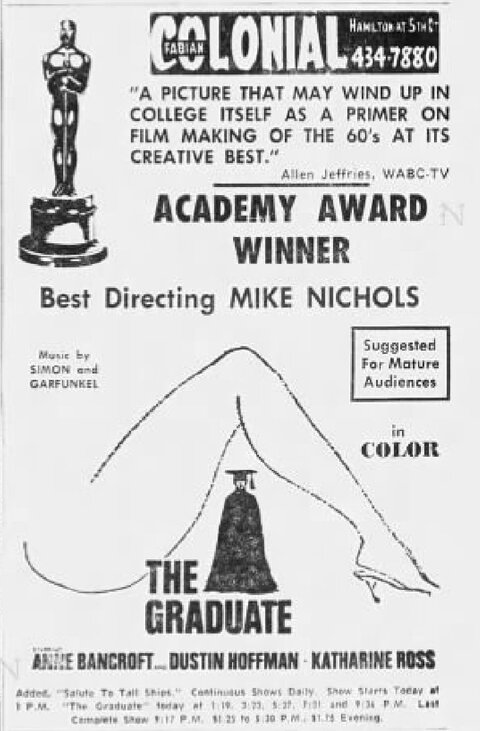
Poster: Public domain, via Wikimedia Commons.
The Graduate · 1967 · Comedy
- Directed by:
- Mike Nichols
- Starring:
- Anne Bancroft, Richard Dreyfuss, Katharine Ross
Mike Nichols directed this famous 1960s comedy about a young man who has just finished his university studies. The story follows him as he struggles to decide what to do with his life now that he is no longer a student.
Domains
- Exam level
- CambridgeCambridgeCambridge English QualificationsThe exam suite from Cambridge University Press & Assessment, from A1 Movers up to C2 Proficiency. The benchmark names double as CEFR labels.B1 PreliminaryIELTSIELTSInternational English Language Testing SystemThe 0–9 band test co-owned by the British Council, IDP, and Cambridge. Used for university entry, work, and migration.4.0–5.0TOEFL iBTTOEFL iBTTest of English as a Foreign Language, Internet-Based TestETS's academic English test, the standard route for US university admissions. Scored 0–120, with a 1–6 scale since 2026.1–6 scale: 3.0–3.544–71TOEICTOEICTest of English for International CommunicationETS's workplace English test, big in Japan and Korea. Listening & Reading scores 10–990 and tops out at C1.550–784
- Frequency
- Common
- Level
- B1 · IntermediateOxford
- Updated
- アルファベット
- 読み方の一覧 →
QR code
englishreference.com/q/graduate
※ 機械で選んだ訳語です。ネイティブスピーカーによる確認はまだです。
「日本語」 data: JMdict (EDRDG), CC BY-SA 4.0