Word
noon
US/ˈnun/
UK/nˈuːn/
Definitions
01midday
A2 · Elementary Uncountable noun
n. twelve o'clock in the middle of the day.
n. the middle of the day, specifically 12:00; the relational boundary between morning and afternoon.
Español:mediodía
“The bells of the old church ring every day at noon.”
“The meeting was scheduled for noon to ensure that all participants could attend before leaving for their respective lunch breaks.”
Synonyms
Antonyms
02the highest point
C1 · Advanced Uncountable noun Literary
n. the time when something is at its strongest or most successful point.
n. the highest point or culmination of something; a figurative zenith.
“The empire reached its noon during the third century.”
“In the noon of his career, the artist was celebrated across Europe, though his fame would later fade into obscurity.”
Antonyms
Collocations
Common phrases and expressions where native English speakers use the word “noon” in context.
Adjective
01. approaching noon
“As the sun climbed higher, signaling approaching noon, the heat became almost unbearable.”
adj + noun
02. sharp at noon
“The ceremony is scheduled to commence sharp at noon, so please ensure you are seated.”
adj + prep + noun
Noun
03. noon deadline
“The journalists were scrambling to finish their articles before the strict noon deadline.”
noun + noun
04. noon sun
“The intense noon sun beat down on the hikers as they reached the summit.”
noun + noun
Preposition
05. around noon
“We usually break for lunch around noon to avoid the rush at the local cafes.”
prep + noun
06. at high noon
“The two rivals agreed to meet in the town square at high noon to settle their dispute.”
prep + adj + noun
07. by noon
“The project manager requested that all department reports be submitted by noon.”
prep + noun
Real-World Examples
“Mourners began arriving from 7.30am for the noon service, bringing camping chairs and supplies, with some having travelled from as far away as Germany and Austria.” “Her family said a celebration of her life will be held at Swansea Minster (St Mary’s Church) on Monday at noon.” Etymology
From Middle English noen, none, non, from Old English nōn (“the ninth hour”), from a Germanic borrowing of classical Latin nōna (“ninth hour”) (short for nōna hōra), feminine of nōnus (“ninth”). Cognate with Dutch noen, obsolete German Non, Norwegian non.
Etymology adapted from Wiktionary, available under CC BY-SA 4.0.
Idioms
01. high noon
The word in film
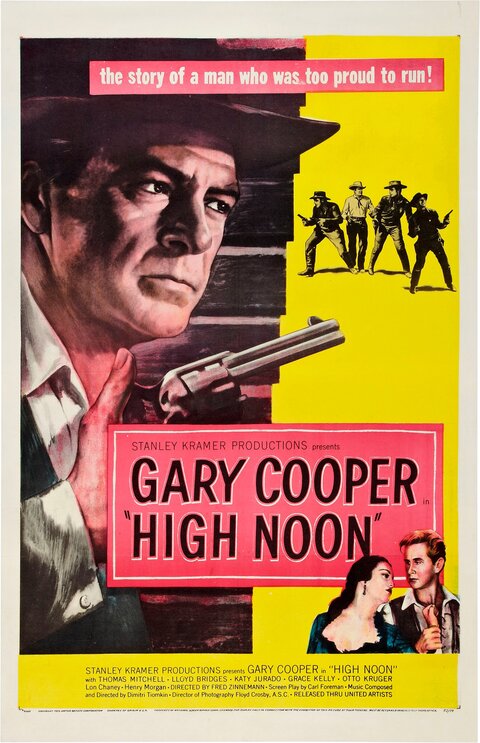
Poster: Public domain, via Wikimedia Commons.
High Noon · 1952 · Western
- Directed by:
- Fred Zinnemann
- Starring:
- Grace Kelly, Gary Cooper, Lee Van Cleef
Fred Zinnemann directed this tense Western about a small-town marshal who must face a vengeful gang of outlaws alone at midday. The title names the exact hour the noon train arrives with the killers, marking the dramatic peak of the town's crisis.
- Exam level
- CambridgeCambridgeCambridge English QualificationsThe exam suite from Cambridge University Press & Assessment, from A1 Movers up to C2 Proficiency. The benchmark names double as CEFR labels.C1 AdvancedIELTSIELTSInternational English Language Testing SystemThe 0–9 band test co-owned by the British Council, IDP, and Cambridge. Used for university entry, work, and migration.7.0–8.0TOEFL iBTTOEFL iBTTest of English as a Foreign Language, Internet-Based TestETS's academic English test, the standard route for US university admissions. Scored 0–120, with a 1–6 scale since 2026.1–6 scale: 5.0–5.595–113TOEICTOEICTest of English for International CommunicationETS's workplace English test, big in Japan and Korea. Listening & Reading scores 10–990 and tops out at C1.945–990
- Frequency
- Common
- Level
- C1 · AdvancedOxford
- Updated
- アルファベット
- 読み方の一覧 →
QR code
englishreference.com/q/noon
Traducciones: Kaikki.org (Wiktionary), CC BY-SA 4.0