Word
Definitions
01manufacturing and production
A2 · Elementary Uncountable noun
n. the companies and factories that make things, especially in large amounts.
n. the sector of an economy concerned with the large-scale production of goods, typically in factories.
“The city grew quickly because of the steel industry and the new jobs it created.”
“Heavy industry declined in the region during the late twentieth century, leading to a significant shift toward service-oriented economic models.”
Synonyms
02a specific branch of business
B1 · Intermediate Countable noun
n. a particular group of businesses that provide the same service or product.
n. a distinct group of productive or profit-making enterprises.
“She has worked in the fashion industry for over ten years.”
“The hospitality industry faced unprecedented challenges during the global travel restrictions, forcing many small businesses to pivot their operations.”
03hard work
C1 · Advanced Uncountable noun Formal
n. the quality of working hard and being productive.
n. the quality of being habitually active, diligent, and hardworking.
“The teacher praised the student for her industry and focus during the project.”
“The success of the startup was attributed more to the sheer industry of its founders than to any initial financial advantage.”
Antonyms
04stone tool classification
C2 · Proficiency Countable noun Archaeology Technical
n. a group of stone tools from a specific time in history.
n. a classification of stone tools belonging to a specific period or culture.
“Archaeologists found evidence of a prehistoric flint industry at the site.”
“The discovery of a sophisticated bone-tool industry suggests that the inhabitants possessed more advanced cognitive abilities than previously assumed.”
Synonyms
Collocations
Common phrases and expressions where native English speakers use the word “industry” in context.
Real-World Examples
“Cut-price Chinese manufacturers could wipe out whole chunks of British industry within five years, a think tank has warned.” “Carmakers are delaying final decisions to invest in UK factories until electric car sales rules are relaxed, according to the head of the British car industry's lobby group.” “Euro zone industry has been broadly stagnant for years and its output is now 3% below its 2021 level as high energy costs, stiffening competition from China, U.S. tariffs, poor productivity growth and low global demand for European cars have all hurt the bloc.” Etymology
From Middle English industry, industrie, from Old French industrie, from Latin industria (“diligence, activity, industry”), from industrius (“diligent, active, zealous”), from Old Latin indostruus (“diligent, active”); origin unknown. Perhaps from indu (“in”) + ūst-, ūstr-, stem of ūrō (“burn, burn up, consume”, verb), related to Old High German ūstrī (“industry”), Old English andūstrian (“to hate, detest”, literally “to be consumed with zeal”).
Etymology adapted from Wiktionary, available under CC BY-SA 4.0.
Word family
NOUN
ADJECTIVE
Related words
Idioms
The word in film
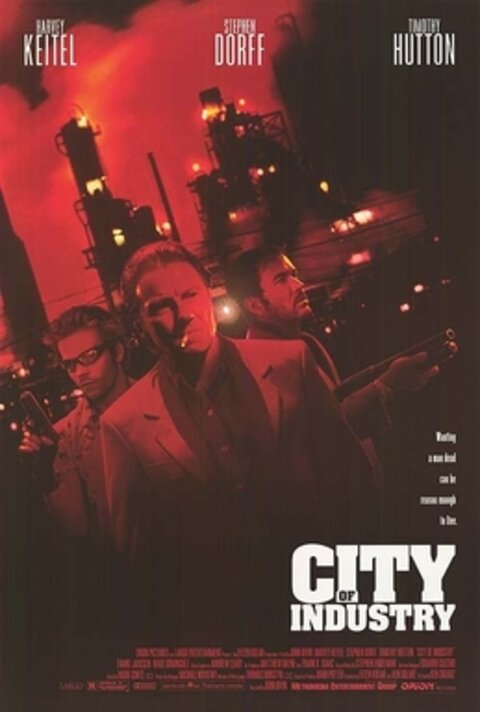
Poster shown under fair use for identification and commentary.
City of Industry · 1997 · Crime
- Directed by:
- John Irvin
- Starring:
- Flex Alexander, Lucy Liu, Famke Janssen
John Irvin's 1997 crime thriller is set in the City of Industry, a Los Angeles suburb known for its factories and warehouses. The title names a place built around manufacturing, the sense of industry as production.
Domains
- Exam level
- CambridgeCambridgeCambridge English QualificationsThe exam suite from Cambridge University Press & Assessment, from A1 Movers up to C2 Proficiency. The benchmark names double as CEFR labels.A2 KeyIELTSIELTSInternational English Language Testing SystemThe 0–9 band test co-owned by the British Council, IDP, and Cambridge. Used for university entry, work, and migration.3.0–4.0TOEFL iBTTOEFL iBTTest of English as a Foreign Language, Internet-Based TestETS's academic English test, the standard route for US university admissions. Scored 0–120, with a 1–6 scale since 2026.1–6 scale: 2.0–2.524–43TOEICTOEICTest of English for International CommunicationETS's workplace English test, big in Japan and Korea. Listening & Reading scores 10–990 and tops out at C1.225–549
- Frequency
- Very common
- Level
- A2 · ElementaryOxford
- Updated
- アルファベット
- 読み方の一覧 →
QR code
englishreference.com/q/industry
「カタカナ語」 data: JMdict (EDRDG), CC BY-SA 4.0