Definitions
01art form or sounds
A1 · Beginner Uncountable noun Music
n. sounds that people make by singing or playing instruments, often to express feelings.
n. an art form and cultural activity whose medium is sound organized in time, typically featuring melody, rhythm, and harmony.
日本語:音楽※
“She loves listening to classical music while she studies in the library.”
“The composer experimented with unconventional rhythms to create music that challenged the audience's expectations of traditional harmony.”
Usage
Uncountable noun; does not take an indefinite article or plural 's'.
Pitfall
I listened to a music.
I listened to some music.
Music is uncountable; you cannot use 'a' with it or make it plural.
Synonyms
02sheet music
B1 · Intermediate Uncountable noun Music
n. the written signs on paper that tell a musician which notes to play.
n. the written or printed representation of a musical composition; notation intended for performance.
Español:música
“He forgot his music at home, so he had to share a book with another violinist.”
“The conductor spent hours annotating his music before the first rehearsal to ensure the orchestra understood his vision for the tempo.”
Usage
Often used without an article when referring to the physical pages during a performance.
03pleasing sounds
B2 · Upper Intermediate Uncountable noun Literary
n. any sound that is very pleasant or beautiful to hear.
n. any sound or combination of sounds characterized by a pleasing or harmonious quality.
“The sound of the rain on the roof was music to her ears.”
“To the weary travellers, the distant babbling of the stream was absolute music after three days in the silent desert.”
Synonyms
04signal jamming
C2 · Proficiency Uncountable noun Computing Technical · Slang
n. the use of electronic signals to block or confuse radio communications.
n. the deliberate transmission of signals intended to disrupt or jam enemy electronic communications.
“The pilots reported heavy music on their radio frequencies during the mission.”
“The electronic warfare unit deployed sophisticated music to mask the fleet's movements from coastal radar installations.”
Teaching tip
This is highly specialized military or technical slang; most native speakers will not recognize this meaning.
Synonyms
Collocations
Common phrases and expressions where native English speakers use the word “music” in context.
Verb
01. like music
“Do you like music?”
verb + noun
02. listen to music
“I listen to music on the bus.”
verb + prep + noun
03. music plays
“The music plays all day in the shop.”
noun + verb
04. music stops
“When the music stops, we stop dancing.”
noun + verb
Adjective
05. live music
“This cafe has live music on Fridays.”
adj + noun
06. loud music
“The loud music hurts my ears.”
adj + noun
07. good music
“This song is good music. I like it a lot.”
adj + noun
Noun
08. music lesson
“I have a music lesson on Monday.”
noun + noun
09. music teacher
“My music teacher is very kind.”
noun + noun
10. a piece of music
“We listened to a piece of music in class.”
11. dance to the music
“The children dance to the music.”
12. listen to good music
“I listen to good music when I cook.”
Real-World Examples
“There aren't many musicians whose sound is so distinctive and influential that the music industry invents a whole new genre to describe it.” “Inside a recording room at Queen Mary University of London, a group of researchers fiddle with novel artificial intelligence (AI) tools to develop what they call the "new virtual worlds" of music.” Etymology
From Middle English musik, musike, borrowed from Anglo-Norman musik, musike, Old French musique, and their source Latin mūsica, from Ancient Greek μουσική (mousikḗ), from Ancient Greek Μοῦσα (Moûsa, “Muse”), an Ancient Greek deity of the arts. By surface analysis, muse + -ic (“pertaining to”). In this sense, displaced native Old English drēam (“music”), whence Modern English dream.
Etymology adapted from Wiktionary, available under CC BY-SA 4.0.
Word family
NOUN
ADJECTIVE
ADVERB
Idioms
The word in film
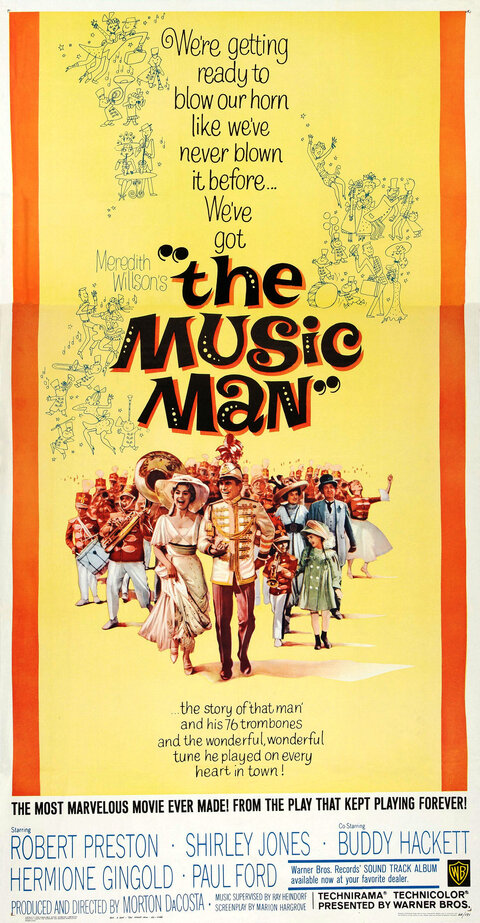
Poster: Public domain, via Wikimedia Commons.
The Music Man · 1962 · Musical
- Directed by:
- Morton DaCosta
- Starring:
- Robert Preston, Shirley Jones, Buddy Hackett
Morton DaCosta directs this joyful musical comedy starring Robert Preston as a charismatic con artist posing as a marching band organizer in small-town Iowa. The title highlights his promise to teach local boys the fundamentals of instrumental harmony, even though he cannot read a single musical note.
Domains
- Exam level
- CambridgeCambridgeCambridge English QualificationsThe exam suite from Cambridge University Press & Assessment, from A1 Movers up to C2 Proficiency. The benchmark names double as CEFR labels.A1 MoversIELTSIELTSInternational English Language Testing SystemThe 0–9 band test co-owned by the British Council, IDP, and Cambridge. Used for university entry, work, and migration.2.0–3.0TOEFL iBTTOEFL iBTTest of English as a Foreign Language, Internet-Based TestETS's academic English test, the standard route for US university admissions. Scored 0–120, with a 1–6 scale since 2026.1–6 scale: 1.0–1.50–23TOEICTOEICTest of English for International CommunicationETS's workplace English test, big in Japan and Korea. Listening & Reading scores 10–990 and tops out at C1.120–224
- Frequency
- Very common
- Level
- A1 · BeginnerOxford
- Updated
- アルファベット
- 読み方の一覧 →
QR code
englishreference.com/q/music
※ 機械で選んだ訳語です。ネイティブスピーカーによる確認はまだです。
「日本語」「カタカナ語」 data: JMdict (EDRDG), CC BY-SA 4.0
Traducciones: Kaikki.org (Wiktionary), CC BY-SA 4.0