Word
country
Phoneticscoun·try, stress on the first syllable
US/ˈkəntɹi/
UK/kˈʌntɹi/
Definitions
01a nation
A1 · Beginner Countable noun
n. a nation or state with its own government and land.
n. the territory of a sovereign state or a nation with distinct political and social institutions.
日本語:国※
Español:país
“How many countries have you visited in Europe?”
“The treaty was signed by over fifty countries, each pledging to reduce carbon emissions over the next decade.”
02rural areas
A2 · Elementary Uncountable noun
n. land that is away from big towns and cities, often with farms and fields.
n. rural areas or the countryside, typically contrasted with urban or industrial environments.
“We love to spend our weekends walking in the country.”
“After years of living in a cramped city apartment, they decided to move to the country for a quieter pace of life.”
Pitfall
I live in country.
I live in the country.
When referring to the countryside, you must use the definite article 'the'.
Synonyms
03music style
B1 · Intermediate Uncountable noun Music
n. a style of popular music that comes from the rural southern US.
n. a genre of popular music originating in the rural southern United States, typically featuring acoustic guitars and fiddles.
“She listens to country whenever she goes for a long drive.”
“The festival features a mix of traditional country and modern folk, attracting fans from across the state.”
Synonyms
04Indigenous lands
C1 · Advanced Uncountable noun Dialect
n. the traditional lands of Indigenous people, including the nature and spirits there.
n. traditional lands of Indigenous people, particularly in Australia, encompassing cultural, spiritual, and ecological values.
“The elders spoke about the importance of caring for Country.”
“The project was developed in close consultation with the local community to ensure the protection of sacred sites on Country.”
Usage
Often capitalized as 'Country' in this specific sense.
Synonyms
05mining rock
C2 · Proficiency Uncountable noun Science Technical
n. the rock that surrounds a vein of metal or coal.
n. the rock through which a vein of ore or coal runs; also known as country rock.
“The miners had to drill through the hard country to reach the gold.”
“Geologists analyzed the interface between the quartz vein and the surrounding country to determine the age of the deposit.”
Synonyms
06rural or rustic
B1 · Intermediate
adj. related to the countryside or a simple, rural way of life.
adj. pertaining to or characteristic of the countryside or rural life.
“The hotel had a lovely country feel with its wooden furniture and fireplace.”
“The menu features traditional country cooking, using ingredients sourced directly from nearby family farms.”
Antonyms
Collocations
Common phrases and expressions where native English speakers use the word “country” in context.
Confusables
Country is a political nation or state, while countryside is the rural land away from cities.
RememberCountry = Nation. Countryside = Nature.
Etymology
From Middle English contre, contree, contreie, from Old French contree, cuntrede, from Vulgar Latin *(terra) contrata (“(land) lying opposite; (land) spread before one”) (also in Medieval Latin as "country, region"), from Latin contrā (“against, opposite”) (whence contra-). Cognate with Scots kintra. Unrelated to county. Displaced native English land in some of its senses. From around 1300 as "area surrounding a walled city or town; the open country." By early 16th century the sense was applied mostly to rural areas, as opposed to towns and cities. Compare typologically Russian страна́ (straná), сторона́ (storoná).
Etymology adapted from Wiktionary, available under CC BY-SA 4.0.
Word family
NOUN
ADJECTIVE
Related words
Idioms
01. country mile
02. line of country
The word in film
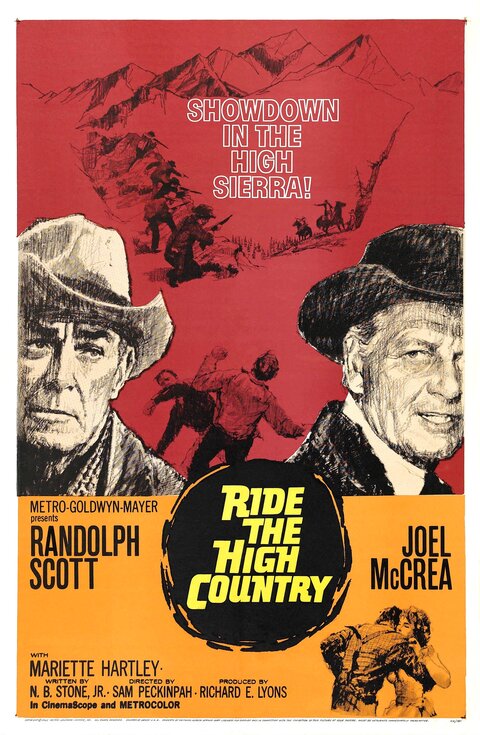
Poster: Public domain, via Wikimedia Commons.
Ride the High Country · 1962 · Western
- Directed by:
- Sam Peckinpah
- Starring:
- Randolph Scott, Joel McCrea, Mariette Hartley
Sam Peckinpah directs this reflective Western about two veteran gunfighters undertaking a perilous journey to transport gold dust. The title names the untamed, mountainous wilderness where law and order have yet to establish firm boundaries.
Domains
- Exam level
- CambridgeCambridgeCambridge English QualificationsThe exam suite from Cambridge University Press & Assessment, from A1 Movers up to C2 Proficiency. The benchmark names double as CEFR labels.A1 MoversIELTSIELTSInternational English Language Testing SystemThe 0–9 band test co-owned by the British Council, IDP, and Cambridge. Used for university entry, work, and migration.2.0–3.0TOEFL iBTTOEFL iBTTest of English as a Foreign Language, Internet-Based TestETS's academic English test, the standard route for US university admissions. Scored 0–120, with a 1–6 scale since 2026.1–6 scale: 1.0–1.50–23TOEICTOEICTest of English for International CommunicationETS's workplace English test, big in Japan and Korea. Listening & Reading scores 10–990 and tops out at C1.120–224
- Frequency
- Very common
- Level
- A1 · BeginnerOxford
- Updated
- アルファベット
- 読み方の一覧 →
QR code
englishreference.com/q/country
※ 機械で選んだ訳語です。ネイティブスピーカーによる確認はまだです。
「日本語」 data: JMdict (EDRDG), CC BY-SA 4.0
Traducciones: Kaikki.org (Wiktionary), CC BY-SA 4.0