Word
creep
US/ˈkɹip/
UK/kɹˈiːp/
Irregular verb
Forms
Infinitive
creep
Past
crept
Past participle
crept
Definitions
01to move quietly
B1 · Intermediate
v. to move slowly and quietly so that people do not hear or see you.
v. to move stealthily or cautiously, often with the body close to the ground, to avoid detection.
“I tried to creep up the stairs so I wouldn't wake my parents.”
“The burglar attempted to creep through the darkened hallway, mindful of the creaking floorboards that might alert the sleeping residents.”
02to change slowly
B2 · Upper Intermediate
v. to happen or change very slowly over a long time.
v. to occur or develop gradually and almost imperceptibly.
“Doubt began to creep into her mind as the deadline approached.”
“Errors began to creep into the data set after the software update, causing significant discrepancies in the final quarterly report.”
03to grow along a surface
B2 · Upper Intermediate
v. to grow along the ground or over a wall instead of growing upwards.
v. to grow along a surface by means of extending stems or roots.
“Ivy started to creep across the old stone walls of the garden.”
“The invasive vines began to creep over the perimeter fence, eventually smothering the native shrubs in the lower garden.”
04an unpleasant person
B2 · Upper Intermediate Countable noun Informal
n. an unpleasant person who makes you feel nervous or uncomfortable.
n. a derogatory term for a person perceived as strange, eccentric, or socially inappropriate, often with a predatory connotation.
“That guy at the party was a total creep; he wouldn't stop staring at us.”
“She felt uneasy when the stranger followed her into the lift, later describing him to security as a complete creep.”
05gradual expansion
C1 · Advanced Uncountable noun Academic · Formal
n. when a project or plan slowly grows bigger than it was supposed to be.
n. the gradual expansion of a project, goal, or boundary beyond its original scope, typically viewed as a negative development.
“We need to finish the project now before more feature creep happens.”
“The manager warned that mission creep was draining the department's resources, distracting the team from their primary objectives.”
Usage
Often used in the compound 'scope creep' in business contexts.
Synonyms
06material deformation
C2 · Proficiency Uncountable noun Science Technical
n. the slow change in the shape of a solid material because of heat or pressure.
n. the slow, progressive deformation of a solid material under constant mechanical stress.
“Engineers must consider the creep of the metal when designing jet engines.”
“The structural integrity of the bridge was compromised by thermal creep, as the lead supports had gradually shifted over decades of extreme temperature fluctuations.”
Synonyms
07geological movement
C2 · Proficiency Uncountable noun Science Technical
n. the very slow movement of soil or rocks down a hill.
n. the slow, imperceptible downslope movement of surface rock and soil particles.
“You can see the effects of soil creep by the way the trees lean on the hillside.”
“Geologists monitored the hillside for signs of creep, noting that the fence line had moved several inches since the previous survey.”
Collocations
Common phrases and expressions where native English speakers use the word “creep” in context.
Verb
01. creep and crawl
“The soldiers had to creep and crawl through the dense undergrowth to remain undetected.”
verb + and + verb
02. creep into the room
“She tried to creep into the room without waking the sleeping baby.”
verb + prep + noun
03. creep silently
“The cat began to creep silently toward the unsuspecting bird in the garden.”
verb + adv
Adjective
04. right creep
“He turned out to be a right creep after he started following her home every day.”
adj + noun
05. total creep
“Everyone at the party agreed that the man staring at them was a total creep.”
adj + noun
Noun
06. creep of age
“He started to notice the slow creep of age in the fine lines around his eyes.”
noun + of + noun
07. mission creep
“The project suffered from mission creep, eventually becoming far more complex than originally planned.”
noun + noun
Preposition
08. on the creep
“The security guard caught the intruder on the creep near the warehouse entrance.”
prep + noun
Real-World Examples
“At the start of April , the age at which you receive it began to gradually creep up, rising from 66 years to 67 years by March 2028.” “The shift toward negativity could theoretically creep into any conversation where you need to stay focused on a particular topic, but there is a risk of running out of things to say.” Etymology
From Middle English crepen, from Old English crēopan (“to creep, crawl”), from Proto-West Germanic kreupan, from Proto-Germanic kreupaną (“to twist, creep”), from Proto-Indo-European *grewbʰ- (“to turn, wind”). Cognates Cognate with West Frisian krûpe (“to creep, crawl”), Central Franconian kruffe (“to creep, crawl”), Dutch kruipen (“to creep, crawl”), Low German krepen, krupen (“to creep, crawl”), Danish krybe (“to creep”), Faroese krúpa (“to creep”), Icelandic krjúpa (“to kneel down, to genuflect, to get down on one's knees”), Norwegian Bokmål krype (“to creep”), Norwegian Nynorsk krjupa, krjupe, krypa, krype (“to creep, crawl”), Swedish krypa (“to creep, crawl”). The noun is derived from the verb. Etymology tree Proto-Indo-European *grewbʰ-der. Proto-Germanic *kreupaną Proto-West Germanic *kreupan Old English crēopan Middle English crepen English creep
Etymology adapted from Wiktionary, available under CC BY-SA 4.0.
Word family
VERB
NOUN
ADJECTIVE
Related words
Idioms
01. mission creep
In Music
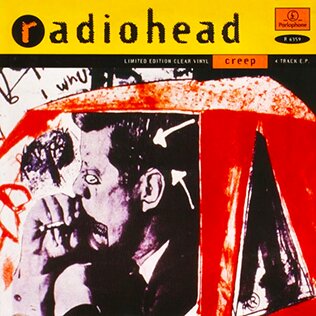
Cover shown under fair use for identification and commentary.
Creep · 1992 · Alternative rock
- Artist:
- Radiohead
- Album:
- Pablo Honey
Radiohead's 1992 debut single is a famous example of the word's noun form. The alternative rock track uses the term to describe a person who feels strange, unpleasant, and out of place while dealing with an obsessive attraction.
Domains
- Exam level
- CambridgeCambridgeCambridge English QualificationsThe exam suite from Cambridge University Press & Assessment, from A1 Movers up to C2 Proficiency. The benchmark names double as CEFR labels.C1 AdvancedIELTSIELTSInternational English Language Testing SystemThe 0–9 band test co-owned by the British Council, IDP, and Cambridge. Used for university entry, work, and migration.7.0–8.0TOEFL iBTTOEFL iBTTest of English as a Foreign Language, Internet-Based TestETS's academic English test, the standard route for US university admissions. Scored 0–120, with a 1–6 scale since 2026.1–6 scale: 5.0–5.595–113TOEICTOEICTest of English for International CommunicationETS's workplace English test, big in Japan and Korea. Listening & Reading scores 10–990 and tops out at C1.945–990
- Frequency
- Frequent
- Level
- C1 · AdvancedOxford
- Updated
- アルファベット
- 読み方の一覧 →
QR code
englishreference.com/q/creep