Word
godzilla
Phoneticsgodzil·la
/ˌɡɑˈdzɪlə/
Countable noun
Definition
n. a famous giant monster from Japanese movies that looks like a dinosaur and destroys cities. People often use the name to describe anything that is unusually large or powerful.
n. a fictional prehistoric sea monster awakened or empowered by nuclear radiation, originally appearing in Japanese cinema. When used metaphorically, it refers to something of enormous size, power, or destructive potential.
Examples
“The new skyscraper is a Godzilla among smaller buildings.”
“The film studio released a new version of Godzilla to celebrate the character's seventieth anniversary.”
“In cultural studies, the figure of Godzilla is frequently analyzed as a metaphor for nuclear trauma and the unintended consequences of scientific hubris.”
Examples
simple
“The new skyscraper is a Godzilla among smaller buildings.”
contextual
“The film studio released a new version of Godzilla to celebrate the character's seventieth anniversary.”
complex
“In cultural studies, the figure of Godzilla is frequently analyzed as a metaphor for nuclear trauma and the unintended consequences of scientific hubris.”
Usage
When used as a common noun, it is often capitalized; it can also be used as a prefix (e.g., 'Godzilla-sized') to emphasize scale.
Real-World Examples
“When Godzilla first reared up from the boiling ocean in 1954, it was the pitiless embodiment of nuclear devastation in a Japanese film that still stands, 70 years on, as the darkest and most sombre monster movie ever made.” “Ever since he first lumbered on to the big screen in Ishiro Honda’s 1954 original film, Godzilla has been more than just a monster.” “For Japanese children, Godzilla is the ultimate scary adult: fierce, honourable, clumsy and a bit out of control.” “Godzilla serves as a powerful metaphor for the persistent struggle of returning home after war.” Etymology
From Japanese ゴジラ (Gojira), a blend coined for the 1954 film from ゴリラ (gorira, "gorilla") and 鯨 (kujira, "whale"). The portmanteau was devised to suggest a creature of colossal scale and primate form.
Etymology adapted from Wiktionary, available under CC BY-SA 4.0.
The word in film
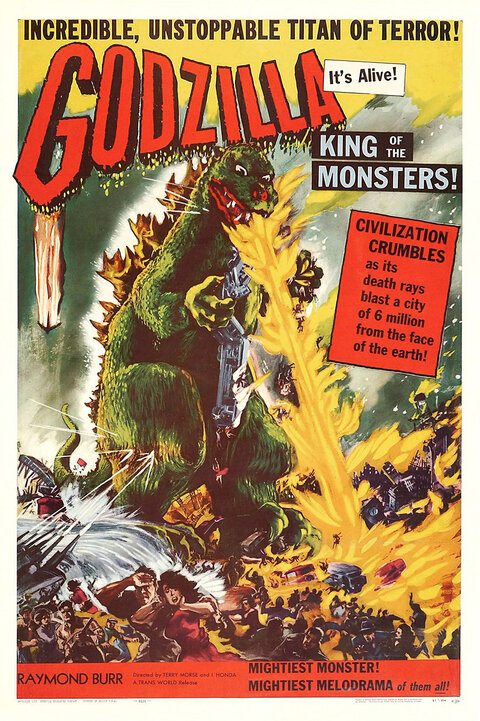
Poster: Public domain, via Wikimedia Commons.
Godzilla · 1954 · Sci-Fi
- Directed by:
- Ishirō Honda
- Starring:
- Takashi Shimura, Momoko Kōchi, Akira Takarada
Ishirō Honda directs this seminal 1954 science fiction film about a colossal prehistoric reptile awakened and empowered by nuclear radiation. The titular creature emerges from the sea to devastate Tokyo, establishing Godzilla as the iconic giant monster that symbolizes catastrophic destructive power in popular culture.
Domains
- Exam level
- CambridgeCambridgeCambridge English QualificationsThe exam suite from Cambridge University Press & Assessment, from A1 Movers up to C2 Proficiency. The benchmark names double as CEFR labels.B1 PreliminaryIELTSIELTSInternational English Language Testing SystemThe 0–9 band test co-owned by the British Council, IDP, and Cambridge. Used for university entry, work, and migration.4.0–5.0TOEFL iBTTOEFL iBTTest of English as a Foreign Language, Internet-Based TestETS's academic English test, the standard route for US university admissions. Scored 0–120, with a 1–6 scale since 2026.1–6 scale: 3.0–3.544–71TOEICTOEICTest of English for International CommunicationETS's workplace English test, big in Japan and Korea. Listening & Reading scores 10–990 and tops out at C1.550–784EikenEikenTest in Practical English ProficiencyThe English proficiency test from the Eiken Foundation of Japan, widely taken by Japanese students. Grades run from 5 to 1, with Pre-1 and Pre-2 between them.Grade 2
- Level
- B1 · Intermediate
- Updated
- アルファベット
- 読み方の一覧 →
QR code
englishreference.com/q/godzilla