Word
native
Phoneticsna·tive, stress on the first syllable
US/ˈneɪtɪv/
UK/nˈeɪtɪv/
Definitions
01place of birth
B1 · Intermediate
adj. describing the place where you were born and grew up.
adj. relating to the place or circumstances of one's birth.
“After twenty years in London, she finally returned to her native village in Scotland.”
“Despite living abroad for decades, he never lost the distinctive accent of his native city, which remained a core part of his identity.”
02biology/nature
B2 · Upper Intermediate Science
adj. describing plants or animals that live naturally in a place, rather than being brought there by people.
adj. originating or occurring naturally in a particular country or region; not introduced or invasive.
“The park is full of native trees that provide food for local birds.”
“Conservationists are working to remove invasive vines that threaten to smother the native flora of the river valley.”
Synonyms
Antonyms
03computing
C1 · Advanced Computing Technical
adj. describing software designed to run on a specific type of computer or system.
adj. designed for or built into a specific system or architecture, rather than running through an emulator or third-party layer.
“The app runs much faster now that it has a native version for this tablet.”
“The developer recommended using native code to ensure the application could fully exploit the hardware's processing power without latency.”
Synonyms
Antonyms
04a local person
B1 · Intermediate Countable noun
n. someone who was born in a particular place.
n. a person born in a specified place or associated with a place by birth.
“As a native of New York, he knew all the best places to eat that tourists never found.”
“The festival is a point of pride for the natives of the island, who spend months preparing the traditional costumes.”
Synonyms
05native speaker
B1 · Intermediate Countable noun
n. someone who has spoken a particular language since they were a baby.
n. a person who has spoken a specified language from earliest childhood.
“If you have a question about a difficult phrase, ask a native.”
“The language school employs several natives to ensure students are exposed to natural intonation and contemporary slang.”
Synonyms
Antonyms
06indigenous person
C1 · Advanced Countable noun Formal
n. a member of the original group of people living in a country before others arrived.
n. a member of the original inhabitants of a region, especially in a colonial context.
“The museum exhibition was designed in collaboration with the local Natives.”
“The treaty sought to protect the land rights of the natives against further encroachment by industrial interests.”
Usage
Often capitalized (Native) when referring to specific groups in North America or Australia.
Teaching tip
In many modern contexts, using 'native' as a noun for a person can be seen as offensive or patronizing due to colonial history; 'indigenous person' or specific group names are often preferred.
Synonyms
Antonyms
Collocations
Common phrases and expressions where native English speakers use the word “native” in context.
Adjective
01. native country
“After ten years abroad, he finally decided to return to his native country.”
adj + noun
02. native language
“Although she lives in London, her native language is Polish.”
adj + noun
03. native speaker
“If you have a question about pronunciation, you should ask a native speaker.”
adj + noun
04. native to the area
“These colorful birds are native to the area and cannot be found anywhere else.”
adj + prep + adj + noun
Noun
05. native of the city
“As a native of the city, she knew all the best places to eat that tourists never found.”
noun + of + adj + noun
06. native plants
“The gardener suggested growing native plants because they survive better in this climate.”
adj + noun
Real-World Examples
“Guarani beekeeper Marcio Karai is devoted to caring for stingless bees native to his home in Brazil, working to ensure that the knowledge of generations is carried on for the next.” “Jataí are native to eastern South America’s Atlantic Forest—one of the most diverse biomes in the world—where Verá Mirim’s people have lived for centuries.” “Melipona eburnea, a species of bee, is native to the Amazon.” “As the forest has fallen, so have populations of native bees.” Etymology
Inherited from Middle English natif, from Old French natif, from Latin nātīvus, from nātus (“birth”). Doublet of naive and neif.
Etymology adapted from Wiktionary, available under CC BY-SA 4.0.
Word family
ADJECTIVE
ADVERB
Related words
Idioms
01. go native
02. native soil
In Literature
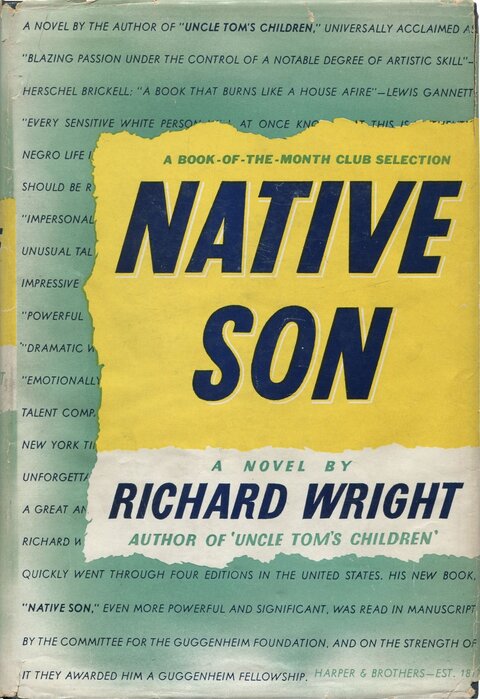
Cover: Public domain, via Wikimedia Commons — Designer uncredited; Published by Harper & Brothers.
Native Son · 1940-03-01 · African american literature, social novel
- Author:
- Richard Wright
Richard Wright’s 1940 social novel follows the life of Bigger Thomas, a young Black man struggling to survive in the impoverished South Side of Chicago. By identifying the protagonist as a "native son," the title highlights how his identity and tragic circumstances were shaped by the systemic racism of the American city where he was born.
Domains
- Exam level
- CambridgeCambridgeCambridge English QualificationsThe exam suite from Cambridge University Press & Assessment, from A1 Movers up to C2 Proficiency. The benchmark names double as CEFR labels.B1 PreliminaryIELTSIELTSInternational English Language Testing SystemThe 0–9 band test co-owned by the British Council, IDP, and Cambridge. Used for university entry, work, and migration.4.0–5.0TOEFL iBTTOEFL iBTTest of English as a Foreign Language, Internet-Based TestETS's academic English test, the standard route for US university admissions. Scored 0–120, with a 1–6 scale since 2026.1–6 scale: 3.0–3.544–71TOEICTOEICTest of English for International CommunicationETS's workplace English test, big in Japan and Korea. Listening & Reading scores 10–990 and tops out at C1.550–784
- Frequency
- Common
- Level
- B1 · IntermediateOxford
- Updated
- アルファベット
- 読み方の一覧 →
QR code
englishreference.com/q/native