Word
slaughterhouse
Phoneticsslaugh·ter·house, stress on the first syllable
US/ˈsɫɔtɝˌhaʊs/
UK/slˈɔːtəhˌaʊs/
Definition
n. a building where animals are killed for food. It is a place where meat is prepared for sale to the public.
n. a facility where animals are slaughtered for human consumption. Often used metaphorically to describe a place of intense violence or destruction.
Examples
“The cows were moved to the slaughterhouse early in the morning.”
“The local community protested the construction of a new slaughterhouse near the residential area.”
“The documentary provides a harrowing look at the industrial slaughterhouse, revealing the scale of the operations and the conditions within the facility.”
Examples
simple
“The cows were moved to the slaughterhouse early in the morning.”
contextual
“The local community protested the construction of a new slaughterhouse near the residential area.”
complex
“The documentary provides a harrowing look at the industrial slaughterhouse, revealing the scale of the operations and the conditions within the facility.”
Real-World Examples
“The researchers also show that many of these slaughterhouses sold beef and leather products into international supply chains around the same time they bought directly or indirectly from ranchers on the Dirty List.” “Emily Thomas visits Tideford Abattoir, a slaughterhouse in the south of England to get an uncomfortably close up view of animals becoming food.” “Demonstrators have demanded the closure of a slaughterhouse after secretive footage captured by an activist revealed the treatment of sheep, which the facility's management termed "appalling and distressing.” “In the upcoming months, all Welsh slaughterhouses will be mandated to install CCTV cameras in areas where live animals are processed, as regulations approved by the Senedd take effect.” Etymology
From slaughter + house.
Etymology adapted from Wiktionary, available under CC BY-SA 4.0.
Word family
NOUN
In Literature
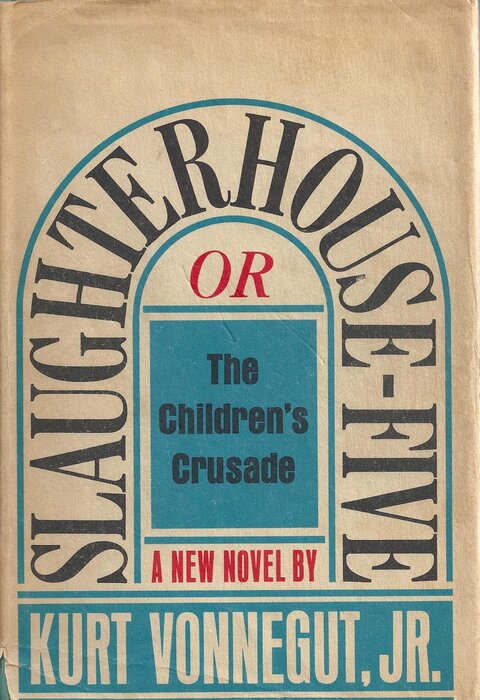
Cover: Public domain, via Wikimedia Commons — Jacket design by Paul Bacon.
Slaughterhouse-Five · 1969-03-01 · Anti-war fiction, black comedy
- Author:
- Kurt Vonnegut
Kurt Vonnegut’s 1969 masterpiece follows Billy Pilgrim, a soldier who survives the firebombing of Dresden during World War II. The title refers to the underground meat-packing cellar where Billy and other prisoners of war are sheltered during the attack. This setting serves as a stark symbol of the industrial-scale destruction and loss of life that the protagonist witnesses throughout the conflict.
- Exam level
- CambridgeCambridgeCambridge English QualificationsThe exam suite from Cambridge University Press & Assessment, from A1 Movers up to C2 Proficiency. The benchmark names double as CEFR labels.B2 FirstIELTSIELTSInternational English Language Testing SystemThe 0–9 band test co-owned by the British Council, IDP, and Cambridge. Used for university entry, work, and migration.5.5–6.5TOEFL iBTTOEFL iBTTest of English as a Foreign Language, Internet-Based TestETS's academic English test, the standard route for US university admissions. Scored 0–120, with a 1–6 scale since 2026.1–6 scale: 4.0–4.572–94TOEICTOEICTest of English for International CommunicationETS's workplace English test, big in Japan and Korea. Listening & Reading scores 10–990 and tops out at C1.785–944EikenEikenTest in Practical English ProficiencyThe English proficiency test from the Eiken Foundation of Japan, widely taken by Japanese students. Grades run from 5 to 1, with Pre-1 and Pre-2 between them.Pre-1
- Frequency
- Occasional
- Level
- B2 · Upper Intermediate
- Updated
- アルファベット
- 読み方の一覧 →
QR code
englishreference.com/q/slaughterhouse