Word
suffragette
Phoneticssuf·fragette
US/ˌsəfɹəˈdʒɛt/
UK/sˌʌfɹɐdʒˈɛt/
Countable noun
Definition
n. a woman who fought for the right to vote in the early 20th century. These women often used public protests and bold actions to demand political equality.
n. a woman seeking the right to vote through organised protest, specifically referring to the militant wing of the British women's suffrage movement. Historically distinguished from 'suffragists' by their use of direct action and civil disobedience.
Examples
“The suffragette marched through the streets to demand the vote.”
“Historians often study how the suffragette movement used visual symbols like purple and green to create a unified political identity.”
Examples
simple
“The suffragette marched through the streets to demand the vote.”
contextual
“Historians often study how the suffragette movement used visual symbols like purple and green to create a unified political identity.”
Usage
Historically specific to the early 1900s; the term is rarely applied to modern voting rights activists.
Real-World Examples
“Anabel believes Jessie's story is fascinating because the history of suffragettes is dominated by middle class protesters like the Pankhursts, as opposed to women from working class backgrounds.” “It's not possible to imagine women winning the vote without the suffragettes," says Ms Connelly.” “The word suffragette, however, was used to describe strictly women, the type who were disrupting local meetings and spitting on policemen, the type who were getting arrested and going on hunger strikes in prison and, in one case, taking an axe to a famous Spanish painting of Venus admiring herself in a mirror, which happened to be hanging in London’s National Gallery.” “Suffragette, as a compound of suffrage (“The casting of a vote, voting; the exercise of a right to vote,” as the Oxford English Dictionary would confirm) plus the suffix – ette, was by no means complimentary.” Etymology
From suffrage + -ette, coined in 1906 by the Daily Mail as a term of contempt for women campaigning for the vote, later reclaimed by the Women's Social and Political Union.
Etymology adapted from Wiktionary, available under CC BY-SA 4.0.
Antonyms
In Music
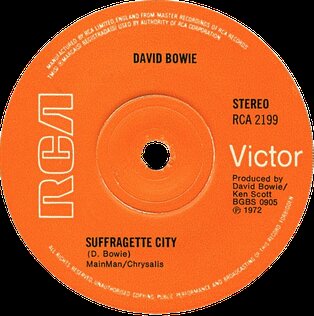
Cover shown under fair use for identification and commentary.
Suffragette City · 1972 · Glam rock
- Artist:
- David Bowie
- Album:
- The Rise and Fall of Ziggy Stardust and the Spiders from Mars
David Bowie released this high-energy glam rock track in 1972 on his famous Ziggy Stardust album. The title uses the word to evoke the image of a modern, rebellious urban environment. It remains one of the artist's most popular songs due to its driving piano and catchy vocal hooks.
Domain
- Exam level
- CambridgeCambridgeCambridge English QualificationsThe exam suite from Cambridge University Press & Assessment, from A1 Movers up to C2 Proficiency. The benchmark names double as CEFR labels.C1 AdvancedIELTSIELTSInternational English Language Testing SystemThe 0–9 band test co-owned by the British Council, IDP, and Cambridge. Used for university entry, work, and migration.7.0–8.0TOEFL iBTTOEFL iBTTest of English as a Foreign Language, Internet-Based TestETS's academic English test, the standard route for US university admissions. Scored 0–120, with a 1–6 scale since 2026.1–6 scale: 5.0–5.595–113TOEICTOEICTest of English for International CommunicationETS's workplace English test, big in Japan and Korea. Listening & Reading scores 10–990 and tops out at C1.945–990EikenEikenTest in Practical English ProficiencyThe English proficiency test from the Eiken Foundation of Japan, widely taken by Japanese students. Grades run from 5 to 1, with Pre-1 and Pre-2 between them.Grade 1
- Frequency
- Occasional
- Level
- C1 · Advanced
- Updated
- アルファベット
- 読み方の一覧 →
QR code
englishreference.com/q/suffragette