Word
Definitions
01animal catcher
B1 · Intermediate Countable noun
n. a piece of equipment used for catching animals.
n. a mechanical device designed to capture or kill animals by containment or physical restraint.
“The farmer set a trap in the barn to catch the mice.”
“The naturalist used a humane trap to capture the injured fox without causing further trauma to its leg.”
02a trick
B2 · Upper Intermediate Countable noun
n. a clever plan used to trick someone into doing something or being caught.
n. a stratagem or deceptive arrangement intended to catch an individual unawares or elicit a confession.
“The police set a trap for the thief by leaving a marked bag in the car.”
“The lawyer realized the witness was walking into a trap when the prosecutor began asking seemingly irrelevant questions about his whereabouts.”
03difficult situation
B2 · Upper Intermediate Countable noun
n. an unpleasant situation that is very hard to get out of.
n. a restrictive or dangerous situation from which escape is difficult or impossible.
“Many young families fall into the debt trap by using too many credit cards.”
“The middle-income trap prevents many developing nations from reaching high-income status due to rising costs and declining competitiveness.”
04the mouth
C1 · Advanced Countable noun Informal · Slang
n. a person's mouth, usually used when telling someone to be quiet.
n. a slang term for the human mouth, typically used in imperative constructions regarding silence.
“He told his brother to shut his trap before he got them both in trouble.”
“The coach yelled at the players to shut their traps and listen to the new strategy for the second half.”
Synonyms
05drug house
C2 · Proficiency Countable noun American English · Slang
n. a place where illegal drugs are sold.
n. a location, such as a residential building or street corner, where illicit drugs are manufactured or distributed.
“The police raided a trap on the corner after neighbors complained about the noise.”
“The documentary explores the social factors that lead young people into the lifestyle associated with the local trap houses.”
Synonyms
06plumbing seal
C1 · Advanced Countable noun Technology Technical
n. a curved pipe under a sink that holds water to stop bad smells from coming up.
n. a U-shaped or S-shaped section of a waste pipe that utilizes a liquid seal to prevent the entry of sewer gases into a building.
“If the sink smells bad, there might be a problem with the trap.”
“The plumber cleared the debris from the P-trap to restore proper drainage and eliminate the persistent odor in the basement.”
Synonyms
07to capture
B1 · Intermediate
v. to catch an animal or person and keep them from escaping.
v. to catch or retain an object, animal, or person within a confined space or device.
“The hikers were trapped in the cave by the rising tide.”
“The insulation is designed to trap heat inside the house during the winter months to reduce energy costs.”
08to trick someone
B2 · Upper Intermediate
v. to trick someone into doing something they did not want to do.
v. to induce someone into a compromising position or an unwanted action through deception.
“She felt trapped into saying yes because all her friends were watching.”
“The journalist was accused of trying to trap the politician into making a controversial statement on camera.”
Synonyms
Collocations
Common phrases and expressions where native English speakers use the word “trap” in context.
Verb
01. escape from a trap
“The fox managed to escape from the trap, but it was badly injured.”
verb + prep + noun
02. fall into a trap
“Don't fall into the trap of thinking that more money will automatically make you happier.”
verb + prep + noun
03. set a trap
“The police set a trap to catch the thieves as they entered the building.”
verb + noun
Adjective
04. deadly trap
“The narrow canyon became a deadly trap when the flash flood hit.”
adj + noun
05. tourist trap
“That restaurant is a total tourist trap; the food is overpriced and the quality is poor.”
adj + noun
Noun
06. poverty trap
“Many families are stuck in a poverty trap where earning more money leads to a loss of benefits.”
noun + noun
07. speed trap
“Slow down on this stretch of the highway because there is often a speed trap.”
noun + noun
Preposition
08. in a trap
“She felt like she was caught in a trap, unable to leave her stressful job.”
prep + noun
Real-World Examples
“Everyone should worry, too, about what happens when a small group of people fall into the same trap.” “Paper traps many of the oils in the coffee, while metal allows them to pass through.” “Beller said she believed the attack had been a trap orchestrated by Cerimedo.” Etymology
From Middle English trappe, from Old English træppe, treppe (“trap, snare”) (also in betræppan (“to trap”)) from Proto-West Germanic trappjā (“trap, snare”), from Proto-West Germanic trappjan (“to step”), from Proto-Germanic trapjaną (“to tread, stamp”), from Proto-Indo-European drebʰ- (“to step, trip, trample”). Cognate with Dutch trap (“step, stair”), German Low German Trapp (“step, stair”). Akin also to West Frisian traap (“stepping, treading, stairway”), German Treppe (“step, stair”), Old English træppan (“to step, tread”). Connection to "step" is "that upon which one steps". French trappe and Spanish trampa are ultimately borrowings from Germanic.
Borrowed from Swedish trapp (“step, stair, stairway”), from Middle Low German trappe (“stair, step”).
Akin to Middle English trappe (“trappings, gear”), and perhaps from Old Northern French trape, a byform of Old French drap, a word of the same origin as English drab (“a kind of cloth”).
Clipping of trapezius.
Etymology adapted from Wiktionary, available under CC BY-SA 4.0.
Word family
NOUN
Idioms
The word in film
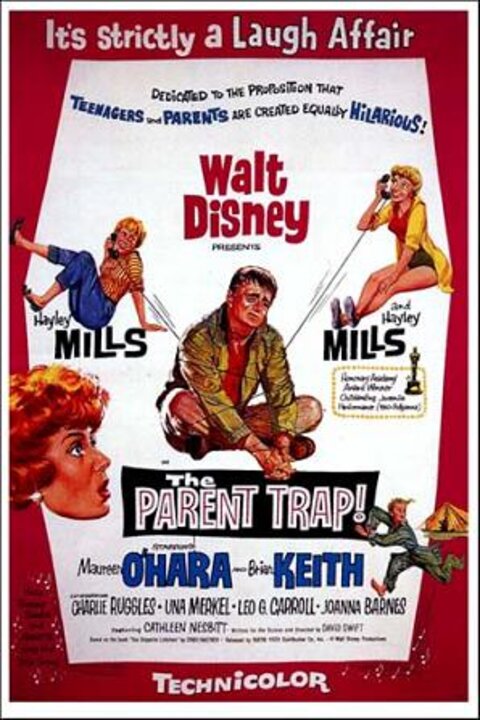
Poster: Public domain, via Wikimedia Commons.
The Parent Trap · 1961 · Comedy
- Directed by:
- David Swift
- Starring:
- Hayley Mills, Maureen O'Hara, Brian Keith
David Swift directs this charming comedy about twin sisters who swap identities to reconcile their divorced mother and father. The title describes their elaborate, good-natured conspiracy to lure their unsuspecting parents into situations that force them to acknowledge their lingering affection.
Domains
- Exam level
- CambridgeCambridgeCambridge English QualificationsThe exam suite from Cambridge University Press & Assessment, from A1 Movers up to C2 Proficiency. The benchmark names double as CEFR labels.B2 FirstIELTSIELTSInternational English Language Testing SystemThe 0–9 band test co-owned by the British Council, IDP, and Cambridge. Used for university entry, work, and migration.5.5–6.5TOEFL iBTTOEFL iBTTest of English as a Foreign Language, Internet-Based TestETS's academic English test, the standard route for US university admissions. Scored 0–120, with a 1–6 scale since 2026.1–6 scale: 4.0–4.572–94TOEICTOEICTest of English for International CommunicationETS's workplace English test, big in Japan and Korea. Listening & Reading scores 10–990 and tops out at C1.785–944
- Frequency
- Common
- Level
- B2 · Upper IntermediateOxford
- Updated
- アルファベット
- 読み方の一覧 →
QR code
englishreference.com/q/trap
「カタカナ語」 data: JMdict (EDRDG), CC BY-SA 4.0
‘외래어’ data: 한국어기초사전 (국립국어원), CC BY-SA 2.0 KR