Word
atlas
Phoneticsat·las, stress on the first syllable
US/ˈætɫəs/
UK/ˈætləs/
Definitions
01book of maps
B1 · Intermediate Countable noun Geography
n. a book that contains many maps of the world or a specific area.
n. a bound collection of maps, often including geographical data, tables, and illustrations.
日本語:地図帳※
“We looked at the atlas to find the exact location of the island.”
“The historical atlas provides a fascinating visual record of how national borders in Europe shifted throughout the nineteenth century.”
Synonyms
02Greek mythology
B2 · Upper Intermediate Uncountable noun Religion
n. a giant from Greek stories who was forced to hold up the sky on his shoulders.
n. a Titan in Greek mythology condemned by Zeus to support the celestial heavens on his shoulders.
“In the old stories, Atlas carries the weight of the world.”
“The sculpture depicts Atlas straining under the immense weight of the celestial sphere, a classic symbol of endurance and burden.”
03neck bone
C2 · Proficiency Countable noun Medicine Technical
n. the very top bone of your spine that supports your head.
n. the first cervical vertebra (C1), which supports the skull and allows for the nodding motion of the head.
“The doctor explained that the atlas bone helps you move your head up and down.”
“A fracture of the atlas is a serious clinical condition that often requires immediate stabilisation of the upper cervical spine.”
Synonyms
04architectural column
C2 · Proficiency Countable noun Architecture Technical
n. a stone carving of a man used like a pillar to hold up a roof.
n. a support sculpted in the form of a man, used in place of a column or pilaster to support an entablature.
“The old building was decorated with stone figures called atlases.”
“The baroque facade is famous for its muscular atlases that appear to struggle under the weight of the heavy stone balcony.”
Synonyms
Antonyms
05visual collection of data
C1 · Advanced Countable noun Academic
n. a book or collection of detailed pictures and information about a specific subject.
n. a bound collection of tables, charts, or illustrations providing a systematic overview of a complex subject.
“The medical student studied an atlas of human cells.”
“The researchers published a comprehensive atlas of the brain, mapping every neural connection with unprecedented detail.”
Synonyms
Real-World Examples
“A new global atlas of underground fungi suggests that some surprising biodiversity hot spots lie hidden beneath our feet.” “Researchers have created the largest atlas of human brain cells so far, revealing more than 3,000 cell types — many of which are new to science.” “The most complete audit ever assembled of Antarctic sea life is to be published this week in the form of an atlas.” “What is a brain atlas, and what makes this one different?” Etymology
Atlas belonged to the Titans, the older and mightier race that ruled before the gods of Olympus. When the young gods rose against them, a war shook the heavens, and the Titans lost. Atlas, strong beyond measure, had stood on the losing side.
Zeus, the victor, did not kill him. He devised something heavier than death. He set Atlas at the western edge of the world, laid the whole weight of the sky across his shoulders, and told him to hold it up forever, so that heaven and earth could never crash together again.
And so he stood, and stands still in the imagination: a giant braced against an endless burden, arms and neck straining under a vault that presses down and never lifts. Travellers said he had turned to stone at last and become a mountain in the far northwest of Africa, the range that still carries his name.
Centuries later a mapmaker in Flanders, Gerardus Mercator, gathered his charts of the whole known world into a single great book. For the cover he wanted a figure who carried the world on his back, and the Titan was the obvious choice. He printed a picture of Atlas shouldering his globe.
The image stuck to the object. Soon any bound collection of maps took the name of the giant on its cover, and that is why the book you pull down to find a country, an ocean, or a range of mountains is called an atlas to this day.
Original etymology written by Shinotoshi Nakamura.
Related words
Stories
The Labors of Hercules · See all Greek myth origin
Twelve impossible tasks set for the strongest of mortals.
a Herculean task — A task requiring enormous strength, effort, or determination to complete.
the labors of Hercules — A long series of extremely difficult challenges that must all be overcome one after another.
like Atlas carrying the world — Bearing a huge, crushing burden or responsibility almost entirely on your own.
The word in film

Poster shown under fair use for identification and commentary.
Atlas · 2024 · Sci-Fi
- Directed by:
- Brad Peyton
- Starring:
- Jennifer Lopez, Lana Parrilla, Mark Strong
Brad Peyton's 2024 science fiction film stars Jennifer Lopez as a data analyst who teams up with a giant robot. Its title echoes the Greek Titan Atlas, who holds up the sky.
In Literature

Cover: Public domain, via Wikimedia Commons — Published by Random House. Jacket design by George Salter.
Atlas Shrugged · 1957-10-10 · Dystopian fiction, mystery fiction
- Author:
- Ayn Rand
Ayn Rand's 1957 novel imagines a world where the country's most capable industrialists and thinkers quietly stop working. The title comes from Atlas, the Greek Titan who holds up the sky, and it suggests what happens when the strongest people refuse to carry everyone else.
In Music
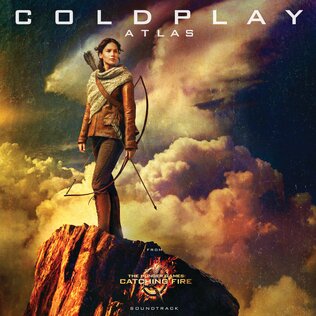
Cover shown under fair use for identification and commentary.
Atlas · 2013 · Alternative rock
- Artist:
- Coldplay
- Album:
- The Hunger Games: Catching Fire – Original Motion Picture Soundtrack
Coldplay's 2013 song, recorded for the soundtrack of The Hunger Games: Catching Fire, takes its title from Atlas, the Titan who holds up the sky in Greek myth. It is an alternative rock track with a big, hopeful sound.
Domains
- Exam level
- CambridgeCambridgeCambridge English QualificationsThe exam suite from Cambridge University Press & Assessment, from A1 Movers up to C2 Proficiency. The benchmark names double as CEFR labels.B1 PreliminaryIELTSIELTSInternational English Language Testing SystemThe 0–9 band test co-owned by the British Council, IDP, and Cambridge. Used for university entry, work, and migration.4.0–5.0TOEFL iBTTOEFL iBTTest of English as a Foreign Language, Internet-Based TestETS's academic English test, the standard route for US university admissions. Scored 0–120, with a 1–6 scale since 2026.1–6 scale: 3.0–3.544–71TOEICTOEICTest of English for International CommunicationETS's workplace English test, big in Japan and Korea. Listening & Reading scores 10–990 and tops out at C1.550–784
- Frequency
- Frequent
- Level
- B1 · Intermediate
- Updated
- アルファベット
- 読み方の一覧 →
QR code
englishreference.com/q/atlas
※ 機械で選んだ訳語です。ネイティブスピーカーによる確認はまだです。
「日本語」 data: JMdict (EDRDG), CC BY-SA 4.0