Word
crowd
US/ˈkɹaʊd/
UK/kɹˈaʊd/
Definitions
01a large group of people
n. a large number of people who have gathered together in the same place.
n. a large number of people gathered together in a disorganized or close-knit body.
“A huge crowd gathered outside the stadium to wait for the band.”
“The police struggled to manage the growing crowd as protesters began to spill over the barricades into the main square.”
Antonyms
02a specific social group
n. a group of people who spend time together or share the same interests.
n. a particular set or clique of people characterized by a common interest or social circle.
“I don't really hang out with the artsy crowd at school.”
“He found himself alienated from the corporate crowd, preferring the company of independent entrepreneurs and freelancers.”
Informal
03to fill a space
v. to move into a space until it is full or uncomfortable.
v. to fill a space by pressing or thronging together; to occupy a space in large numbers.
“Shoppers began to crowd the aisles as soon as the sale started.”
“Commuters began to crowd the platform, pushing forward in anticipation of the final train of the evening.”
04to stand too close
v. to stand or move too close to someone in a way that makes them uncomfortable.
v. to press or stand uncomfortably close to someone, often used in the context of personal space.
“I felt like the person behind me in line was starting to crowd me.”
“The defender was warned by the referee for crowding the striker before the ball was even in play.”
05nautical usage
v. to use too many sails on a boat to try and go faster.
v. to carry an excessive amount of sail in an attempt to maximize speed, often at the risk of safety.
“The captain decided to crowd sail to reach the port before the storm hit.”
“In a desperate bid to outrun the privateers, the merchant vessel began to crowd sail despite the rising gale.”
Technical
Usage
Usually appears in the phrase 'to crowd sail'.
Real-World Examples
“Compared with most other tennis tournaments, the U.S. Open has long been characterized as crowded, rowdy, loud and expensive, a quartet of adjectives that also reflects the city that hosts tennis’s blockbuster event.” “Crowd crushes are wholly preventable, predictable and avoidable, experts say.” “Crowds can be lethal – but also surprisingly rational.” “These crowded places are not just inconvenient; they can also be dangerous.” Etymology
From Middle English crouden, from Old English crūdan, from Proto-West Germanic krūdan, from Proto-Germanic krūdaną, kreudaną, ultimately from Proto-Indo-European grewt- (“to push; press”). Cognate with German Low German kroden (“to push, shove”), Dutch kruien (“to push, shove”).
Inherited from Middle English crowde, from Welsh crwth or a Celtic cognate.
Etymology adapted from Wiktionary, available under CC BY-SA 4.0.
Collocations
Related words
Idioms
beat the crowd — To arrive at a location or complete a task before a large group of people do so.
crowd in on — To join when not wanted; to force one's way into a situation where one is unwelcome.
crowd sail — To carry an unusual amount of sail in an attempt to accelerate the speed of a vessel.
follow the crowd — To conform to majority beliefs, opinions, or practices.
shout fire in a crowded theater — To say something which is not protected by the First Amendment's right to freedom of speech because it would incite violence, panic or lawlessness.
work the crowd — To work the room, or to do the equivalent with an outdoor audience.
wrong crowd — A group of people deemed to have a negative influence on a person's behavior; a bad crowd.
In Literature
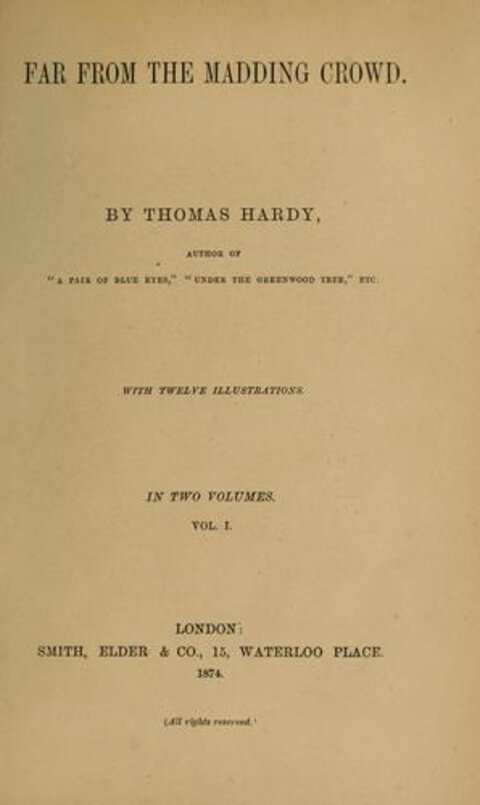
Cover: Public domain, via Wikimedia Commons — Thomas Hardy; Smith, Elder & Co (Life time: 1928).
Far from the Madding Crowd · 1874-01-01 · Novel
- Author:
- Thomas Hardy
Thomas Hardy’s 1874 novel follows the life of Bathsheba Everdene, a headstrong woman managing a farm in the English countryside. The title uses the headword to describe the quiet, rural setting, which stands in contrast to the noisy and chaotic groups of people found in busy urban areas. As Bathsheba navigates her relationships with three different men, the story explores the peace found away from the pressures of modern society.