Definitions
01agricultural land
A1 · Beginner Countable noun Agriculture
n. an area of land and its buildings used for growing crops or raising animals.
n. a tract of land, including associated buildings, dedicated to the cultivation of crops or the husbandry of livestock.
日本語:農場※
“They live on a small farm where they grow organic vegetables and keep chickens.”
“The family-run farm transitioned to sustainable viticulture after decades of intensive wheat production.”
Synonyms
02industrial/server group
B2 · Upper Intermediate Countable noun Computing Technical
n. a group of similar things, like computers or wind turbines, kept in one place.
n. a collection of similar equipment or structures, such as servers or turbines, functioning as a coordinated system.
日本語:ファーム※
“The company maintains a huge server farm to handle all the website traffic.”
“The offshore wind farm consists of fifty turbines capable of powering the entire coastal district.”
03to work the land
A2 · Elementary Agriculture
v. to grow crops or look after animals as a job.
v. to engage in the business of agriculture; to cultivate land or manage livestock for production.
“His family has farmed this land for over three generations.”
“Smallholders in the region continue to farm the steep hillsides using traditional manual techniques.”
04gaming/digital collection
B2 · Upper Intermediate Computing Slang · Informal
v. to do the same task many times in a game to get rewards or items.
v. to perform repetitive actions in a digital environment to accumulate currency, experience, or specific items.
“I spent all weekend farming for rare materials to upgrade my character's armour.”
“Players often farm the lower-level dungeons to gather the resources necessary for high-tier crafting.”
Synonyms
05to farm out
B2 · Upper Intermediate
v. to give work to other people or companies instead of doing it yourself.
v. to delegate or subcontract tasks or functions to an external party.
“The main office decided to farm out the accounting work to a local firm.”
“The agency chose to farm out the graphic design components of the campaign to a specialised boutique studio.”
Usage
Usually used as the phrasal verb 'farm out'.
Synonyms
Real-World Examples
“More than 1,000 metres down, researchers in North Yorkshire have created the world’s deepest underground farm and are running trials for a project that could transform UK food production.” “Farmers will also get £15m in support for building on-farm reservoirs to provide supplies during future dry summers.” “Drought and extreme heat are killing plants, driving up prices while also making some farms economically unviable.” “Under this approach to regenerative farming, nurturing diverse soil communities – from bacteria and fungi to microscopic animals and worms – is seen as an essential prerequisite for growing healthy foods with minimal or no use of agrochemicals or soil-damaging machinery.” Etymology
Inherited from Middle English ferme, farme (“rent, revenue, produce, factor, stewardship, meal, feast”), influenced by Anglo-Norman ferme (“rent, lease, farm”), from Medieval Latin ferma, firma. There is debate as to whether Medieval Latin acquired this term from Old English feorm (“rent, provision, supplies, feast”), from Proto-Germanic fermō, firhuma- (“means of living, subsistence”), from Proto-Germanic ferhwō (“life force, body, being”), from Proto-Indo-European perkʷ- (“life, force, strength, tree”); or from Latin firmus (“solid, secure”), from Proto-Italic fermos, from Proto-Indo-European dʰer-mo-s (“holding”), from the root *dʰer- (“to hold”). If the former etymology is correct, the term is related to Old English feorh (“life, spirit”), Icelandic fjör (“life, vitality, vigour, animation”), Gothic 𐍆𐌰𐌹𐍂𐍈𐌿𐍃 (fairƕus, “the world”). Compare also Old English feormehām (“farm”), feormere (“purveyor, supplier, grocer”). Cognate with Scots ferm (“rent, farm”).
From Middle English fermen, from Anglo-Norman fermer (“to let out for a fixed payment, lease, rent”) ultimately from the same Old English source as Etymology 1. Compare Old English feormian (“to feed, supply with food, sustain”).
From Middle English fermen, from Old English feormian (“to clean, cleanse”), from Proto-West Germanic *furbēn (“to clean, polish, buff”). Doublet of furbish.
Etymology adapted from Wiktionary, available under CC BY-SA 4.0.
Word family
NOUN
Related words
Idioms
In Literature
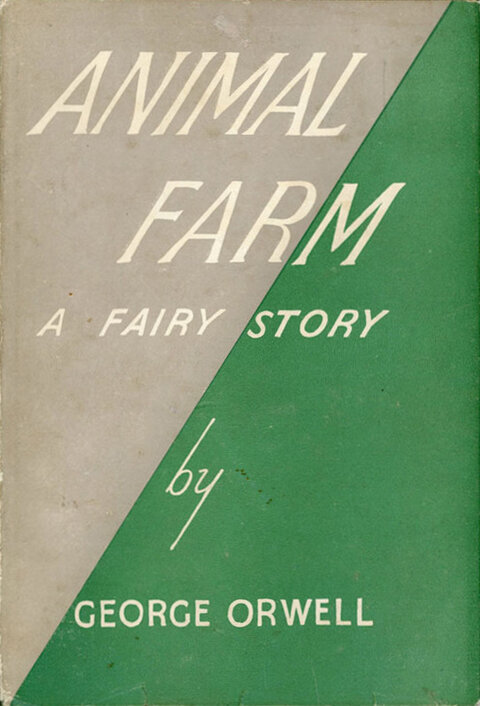
Cover: Public domain, via Wikimedia Commons — Unknown authorUnknown author.
Animal Farm · 1945-08-17 · Dystopian fiction, fable
- Author:
- George Orwell
George Orwell’s 1945 novella tells the story of a group of animals who rebel against their human owner to run Manor Farm themselves. While they initially hope to create a fair society where everyone shares the work and the land, the pigs eventually take control and become as cruel as the humans they replaced.
Domains
- Exam level
- CambridgeCambridgeCambridge English QualificationsThe exam suite from Cambridge University Press & Assessment, from A1 Movers up to C2 Proficiency. The benchmark names double as CEFR labels.A1 MoversIELTSIELTSInternational English Language Testing SystemThe 0–9 band test co-owned by the British Council, IDP, and Cambridge. Used for university entry, work, and migration.2.0–3.0TOEFL iBTTOEFL iBTTest of English as a Foreign Language, Internet-Based TestETS's academic English test, the standard route for US university admissions. Scored 0–120, with a 1–6 scale since 2026.1–6 scale: 1.0–1.50–23TOEICTOEICTest of English for International CommunicationETS's workplace English test, big in Japan and Korea. Listening & Reading scores 10–990 and tops out at C1.120–224
- Frequency
- Common
- Level
- A1 · BeginnerOxford
- Updated
- アルファベット
- 読み方の一覧 →
QR code
englishreference.com/q/farm
※ 機械で選んだ訳語です。ネイティブスピーカーによる確認はまだです。
「日本語」「カタカナ語」 data: JMdict (EDRDG), CC BY-SA 4.0