Word
quicksand
Phoneticsquick·sand, stress on the first syllable
US/ˈkwɪkˌsænd/
UK/kwˈɪksænd/
Uncountable noun
Definition
n. a deep mass of loose, wet sand that looks solid but will pull you down if you step on it. It is often found near water or in marshes.
n. a deep mass of loose sand mixed with water that yields under weight and traps objects or organisms. Often used metaphorically to describe a difficult situation that is hard to escape.
Examples
“The hikers stayed away from the wet riverbank to avoid quicksand.”
“In the movie, the hero almost drowns in quicksand before his friend pulls him out with a long rope.”
“The legal dispute became a professional quicksand, slowly consuming his time and resources until he had no energy left for his actual work.”
Examples
simple
“The hikers stayed away from the wet riverbank to avoid quicksand.”
contextual
“In the movie, the hero almost drowns in quicksand before his friend pulls him out with a long rope.”
complex
“The legal dispute became a professional quicksand, slowly consuming his time and resources until he had no energy left for his actual work.”
Real-World Examples
“Quicksand usually consists of sand or clay and salt that’s become waterlogged, often in river deltas.” “Real quicksand, the kind that is almost impossible to extricate yourself from, is not just water and sand.” “A person trapped in salt-lake quicksand is not in any danger of being sucked under completely.” “Although horror films frequently depict victims disappearing in quicksand, the truth is much tamer.” Etymology
From Old English cwecesand, a compound of cwic ("living") and sand, the term entered Middle English as quyksande. The "quick" element carried its older sense of animate or moving — the sand that shifts and swallows as if alive. Cognates persist in Swedish kvicksand and Icelandic kviksandur, kviksyndi.
Etymology adapted from Wiktionary, available under CC BY-SA 4.0.
Synonyms
In Music
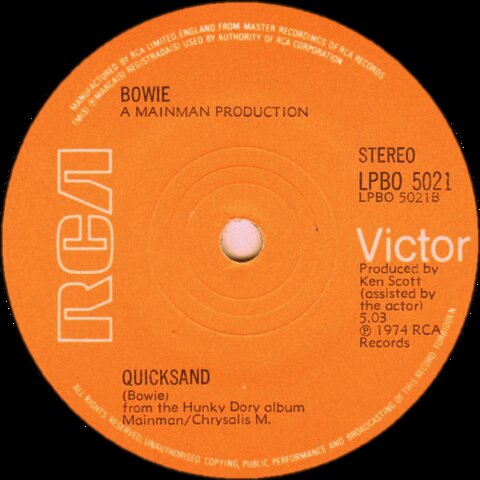
Cover: Public domain, via Wikimedia Commons — RCA Records.
Quicksand · 1971
- Artist:
- David Bowie
- Album:
- Hunky Dory
David Bowie released this folk-rock track on his 1971 album Hunky Dory. The title uses the word figuratively to describe a feeling of being trapped in a hopeless situation where every struggle only makes things worse.
- Exam level
- CambridgeCambridgeCambridge English QualificationsThe exam suite from Cambridge University Press & Assessment, from A1 Movers up to C2 Proficiency. The benchmark names double as CEFR labels.B2 FirstIELTSIELTSInternational English Language Testing SystemThe 0–9 band test co-owned by the British Council, IDP, and Cambridge. Used for university entry, work, and migration.5.5–6.5TOEFL iBTTOEFL iBTTest of English as a Foreign Language, Internet-Based TestETS's academic English test, the standard route for US university admissions. Scored 0–120, with a 1–6 scale since 2026.1–6 scale: 4.0–4.572–94TOEICTOEICTest of English for International CommunicationETS's workplace English test, big in Japan and Korea. Listening & Reading scores 10–990 and tops out at C1.785–944
- Frequency
- Occasional
- Level
- B2 · Upper Intermediate
- Updated
- アルファベット
- 読み方の一覧 →
QR code
englishreference.com/q/quicksand