Word
scarlet
Phoneticsscar·let, stress on the first syllable
US/ˈskɑɹɫət/
UK/skˈɑːlət/
Definitions
01bright red
B2 · Upper Intermediate
adj. having a very bright, strong red colour.
adj. of a brilliant red colour, typically with a slight orange tint.
“The soldiers looked very smart in their traditional scarlet uniforms.”
“The autumn leaves turned a vibrant scarlet, creating a stunning contrast against the grey stone of the old manor house.”
02the colour
B2 · Upper Intermediate Uncountable noun
n. a bright red colour.
n. a brilliant red colour; also refers to cloth of this specific hue.
Español:escarlata
“She chose a dress in a deep shade of scarlet for the party.”
“The cardinal was dressed in scarlet, a colour traditionally reserved for high-ranking officials in the church.”
Usage
Often used as an uncountable noun when referring to the colour itself.
Synonyms
03embarrassed
C1 · Advanced Informal · Dialect
adj. feeling very embarrassed, making your face turn red.
adj. blushing deeply due to intense embarrassment or mortification.
“I was absolutely scarlet when I realised I had called him by the wrong name.”
“She went scarlet with shame after her mistake was pointed out in front of the entire department.”
Usage
Commonly used in British and Irish English to describe a physical reaction to shame.
Teaching tip
Learners should be aware that this is quite informal and often used in the phrase 'to go scarlet'.
04sinful
C2 · Proficiency Literary · Archaic
adj. used in old stories to describe someone who has done something very wrong or immoral.
adj. characterised by sin or immorality; frequently used in literary or biblical contexts.
“In the old novel, the character was punished for her scarlet sins.”
“The poem uses scarlet imagery to represent the moral corruption of the city's ruling class.”
Usage
Often appears in the fixed phrase 'scarlet woman' or 'scarlet sins'.
Teaching tip
This sense is mostly found in older literature and is rarely used to describe modern behaviour without a sense of irony.
05to dye red
C2 · Proficiency Literary
v. to colour something bright red.
v. to dye, tinge, or colour something with a scarlet hue.
“The setting sun began to scarlet the clouds along the horizon.”
“The artisan used traditional methods to scarlet the silk threads before weaving the ceremonial robe.”
Usage
Usually transitive, requiring a direct object.
Teaching tip
The verb form is much rarer than the adjective or noun; it is almost exclusively found in poetic or highly descriptive writing.
Real-World Examples
“In the Roman Catholic Church, scarlet is the color worn by a cardinal, and is associated with the blood of Christ and the Christian martyrs, and with sacrifice.” “We begin our ascent, pausing to photograph curlicued and wispy plants right out of Dr Seuss, yellow, scarlet and blue wildflowers, an orange moth sitting on purple brush.” “Scarlet macaws are an iconic but declining tropical bird.” “By 2015 — the peak of California’s worst drought in at least 10,000 years — the scarlet monkeyflower had all but vanished from its creekside habitat in Sequoia National Park.” In Literature
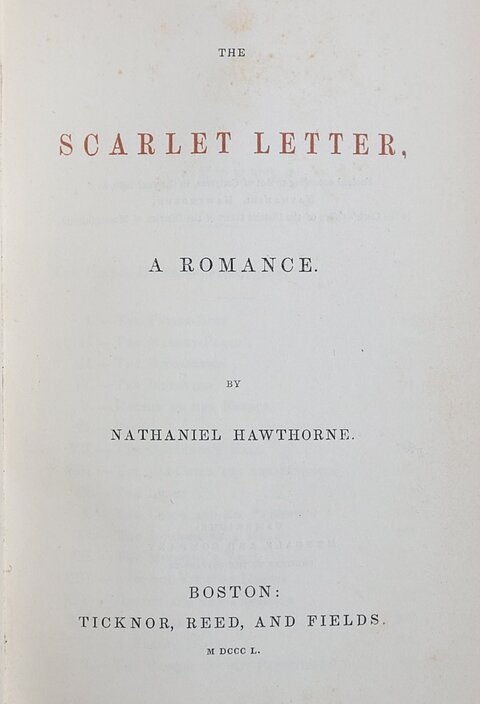
Cover: Public domain, via Wikimedia Commons — Nathaniel Hawthorne.
The Scarlet Letter · 1850-01-01 · Historical fiction, romantic fiction
- Author:
- Nathaniel Hawthorne
Nathaniel Hawthorne’s 1850 novel follows Hester Prynne, a woman living in a strict Puritan community who is forced to wear a bright red 'A' on her clothing as a mark of her past mistakes. This vibrant scarlet letter serves as a constant, visible symbol of her social exclusion and the guilt she is expected to feel. The story explores how she maintains her dignity while carrying this permanent, colorful badge of shame.
- Exam level
- CambridgeCambridgeCambridge English QualificationsThe exam suite from Cambridge University Press & Assessment, from A1 Movers up to C2 Proficiency. The benchmark names double as CEFR labels.B2 FirstIELTSIELTSInternational English Language Testing SystemThe 0–9 band test co-owned by the British Council, IDP, and Cambridge. Used for university entry, work, and migration.5.5–6.5TOEFL iBTTOEFL iBTTest of English as a Foreign Language, Internet-Based TestETS's academic English test, the standard route for US university admissions. Scored 0–120, with a 1–6 scale since 2026.1–6 scale: 4.0–4.572–94TOEICTOEICTest of English for International CommunicationETS's workplace English test, big in Japan and Korea. Listening & Reading scores 10–990 and tops out at C1.785–944
- Frequency
- Frequent
- Level
- B2 · Upper Intermediate
- Updated
- アルファベット
- 読み方の一覧 →
QR code
englishreference.com/q/scarlet
Traducciones: Kaikki.org (Wiktionary), CC BY-SA 4.0