Word
devil
Phoneticsdev·il, stress on the first syllable
US/ˈdɛvəɫ/
UK/dˈɛvəl/
Definitions
01evil spirit
B1 · Intermediate Countable noun Religion
n. the most powerful evil spirit in some religions, often shown with horns and a tail.
n. the supreme spirit of evil; the personification of a hostile and destructive force in various religious traditions.
日本語:悪魔※
“In many old stories, the hero has to trick the devil to save his soul.”
“The folklore of the region is replete with tales of commoners outsmarting the devil at a crossroads to regain their lost fortunes.”
02mischievous person
B2 · Upper Intermediate Countable noun Informal
n. a person, especially a child, who is very naughty or full of energy.
n. a person who is spirited, reckless, or mischievous; frequently applied to children in a lighthearted manner.
“That little devil hid my car keys just for fun.”
“The boy is a total devil when his parents aren't watching, though he maintains a perfectly innocent facade in their presence.”
03unfortunate or lucky person
B2 · Upper Intermediate Countable noun Informal
n. a person you feel sorry for or who is very lucky, used in phrases like 'poor devil'.
n. a person, typically male, used to express a specific evaluation of their circumstances, usually appearing in fixed phrases.
“The poor devil lost his job and his house in the same week.”
“He is a lucky devil to have survived that crash without a single scratch on him.”
04something difficult
C1 · Advanced Countable noun Informal
n. something that is very hard to do or understand.
n. an object, task, or situation that is exceptionally awkward, troublesome, or difficult to manage.
“This old car engine is a devil to start in the winter.”
“The final section of the exam was a real devil, requiring a level of technical knowledge that few students possessed.”
05to cook with spice
B2 · Upper Intermediate Cooking
v. to prepare food, like eggs or meat, with a lot of hot spices.
v. to prepare food with hot seasoning or spices, typically involving mustard, pepper, or cayenne.
“She decided to devil the eggs for the summer picnic.”
“The chef chose to devil the kidneys, serving them on toast with a generous dusting of cayenne pepper for the breakfast menu.”
06to annoy
C2 · Proficiency Informal
v. to bother or annoy someone.
v. to harass, pester, or annoy someone persistently.
“Stop devilling your sister and go outside to play.”
“He spent the entire afternoon devilling his colleagues with trivial questions, preventing any real work from being accomplished.”
Collocations
Common phrases and expressions where native English speakers use the word “devil” in context.
Verb
01. bargain with the devil
“In the classic tale, the protagonist makes a desperate bargain with the devil to gain eternal youth.”
verb + prep + noun
02. believe in the devil
“Many theological scholars debate whether modern societies still believe in the devil as a literal entity.”
verb + prep + noun
03. exorcise the devil
“The priest was summoned to the village to exorcise the devil from the possessed child.”
verb + noun
Adjective
04. incarnate devil
“The dictator was described by his victims as an incarnate devil who took pleasure in their suffering.”
adj + noun
05. wicked devil
“The antagonist in the play is portrayed as a wicked devil, manipulating everyone for his own gain.”
adj + noun
Noun
06. pact with the devil
“The politician was accused of making a secret pact with the devil to secure his victory.”
noun + prep + noun
07. work of the devil
“In the 17th century, many scientific discoveries were dismissed by the church as the work of the devil.”
noun + of + noun
Preposition
08. possessed by the devil
“The townspeople were convinced that the strange behavior of the girl meant she was possessed by the devil.”
prep + noun
Usage
Often capitalized when referring to the specific religious figure; used with the definite article 'the'.
Real-World Examples
“It seems there were a few reasons he got the boot, one of them being that old devil called results.” “Caught between the sand dunes of Seaton Carew and the smoking chimneys of Hartlepool, this landscape was fertile ground for a young imagination alive to stories of witches and devils.” Etymology
The English devil derives from the Old English dēofol, which in turn descends from the Latin diabolus, itself borrowed from the Ancient Greek diábolos (διάβολος). The word thus passed successively from Greek to Latin, from Latin to Old English, and thence into modern usage.
Ancient Greek · διάβολος (diábolos) The Greek term signified "slanderer," "accuser," or "one who falsely accuses." It is worth noting that the modern word began its existence not as a designation for a monster, but as a term for a false accuser.
Latin · diabolus The Greek word was adopted into Latin, where it retained its religious signification.
Old English · dēofol (circa the early medieval period) The Latin-derived term entered Old English through the spread of Christianity—an illustration of language advancing in tandem with belief.
Modern English · devil The spelling and pronunciation gradually evolved into the form current today.
The original meaning The Greek diábolos is related to the verb diabállein (διαβάλλειν), meaning "to slander," "to defame," or "to bring accusations against someone." It is traditionally analysed into two constituent elements:
dia- (διά): across, through, or between
bállein (βάλλειν): to throw
Taken literally, these components suggest a sense akin to "to throw across." The established meaning of the verb, however, was to slander or malign. The modern word devil therefore developed from a term denoting an accuser or slanderer into the designation of the supernatural adversary in Christian theology.
Connection to the Bible The Greek diábolos appears both in the Greek translation of the Hebrew Scriptures and in the New Testament. In Christian usage, it became a title for Satan—the adversary who tempts, accuses, and opposes humanity.
The Hebrew name Satan (שָׂטָן), by contrast, derives from a word meaning "adversary" or "accuser." Although the two terms possess related religious associations, they originate from distinct linguistic roots and ought not to be conflated.
Original etymology written by Shinotoshi Nakamura.
Related words
Idioms
01. blue devils
03. devil dancing
06. devil's advocate
07. devil's luck
08. folk devil
Show all 18
12. speak of the devil and he appears
13. speak of the devil and he shall appear
15. the devil
17. the devil is in the details
18. what the Devil
The word in film
The Devil Wears Prada · 2006 · Comedy
- Directed by:
- David Frankel
- Starring:
- Stephanie Szostak, Heidi Klum, Gisele Bündchen
In this 2006 comedy, a young writer lands a job at a top fashion magazine. Her boss is cold, demanding, and hard to please. The title uses the devil in its older sense, a cruel and powerful figure.
The Devil's Advocate · 1997 · Mystery
- Directed by:
- Taylor Hackford
- Starring:
- Chris Bauer, Al Pacino, Keanu Reeves
In this 1997 thriller, a young lawyer joins a powerful New York firm. Its charming boss offers him a great career, but the price is far higher than he expects. Here, the devil is an evil spirit who tempts people.
In Music
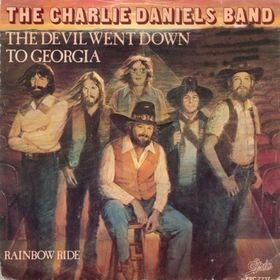
Cover shown under fair use for identification and commentary.
The Devil Went Down to Georgia · 1979 · Bluegrass music
- Artist:
- Charlie Daniels
- Album:
- Million Mile Reflections
In this 1979 hit, a fiddler challenges the devil to a contest in Georgia. The devil is an evil spirit, but the song makes him a playful rival. The fast, bright music turns a dark story into a game.
Domains
- Exam level
- CambridgeCambridgeCambridge English QualificationsThe exam suite from Cambridge University Press & Assessment, from A1 Movers up to C2 Proficiency. The benchmark names double as CEFR labels.C1 AdvancedIELTSIELTSInternational English Language Testing SystemThe 0–9 band test co-owned by the British Council, IDP, and Cambridge. Used for university entry, work, and migration.7.0–8.0TOEFL iBTTOEFL iBTTest of English as a Foreign Language, Internet-Based TestETS's academic English test, the standard route for US university admissions. Scored 0–120, with a 1–6 scale since 2026.1–6 scale: 5.0–5.595–113TOEICTOEICTest of English for International CommunicationETS's workplace English test, big in Japan and Korea. Listening & Reading scores 10–990 and tops out at C1.945–990
- Frequency
- Common
- Level
- C1 · AdvancedOxford
- Updated
- アルファベット
- 読み方の一覧 →
QR code
englishreference.com/q/devil
※ 機械で選んだ訳語です。ネイティブスピーカーによる確認はまだです。
「日本語」 data: JMdict (EDRDG), CC BY-SA 4.0