Word
evil
US/ˈivəɫ/
UK/ˈiːvəl/
Definitions
01morally bad
B1 · Intermediate
adj. very cruel, bad, or morally wrong.
adj. profoundly immoral or malevolent in character or intent.
日本語:悪い※
“In many old stories, the hero must defeat an evil king to save the land.”
“The philosopher argued that no human is born inherently evil, but rather that circumstances and choices shape a person's moral compass.”
02harmful or unpleasant
B2 · Upper Intermediate
adj. causing harm or having a very unpleasant quality, like a bad smell or mood.
adj. tending to cause harm, distress, or misfortune; can also describe sensory experiences that are intensely unpleasant.
日本語:悪い※
“An evil smell was coming from the old bins behind the restaurant.”
“The sailors watched the horizon with concern, noting the evil look of the gathering storm clouds.”
Antonyms
03bad practice
C1 · Advanced Computing Slang · Technical
adj. something that is considered a bad idea or a poor way of doing things.
adj. describes a practice or method that is considered undesirable, inefficient, or likely to cause technical problems.
日本語:悪い※
“Most programmers agree that using global variables like that is evil.”
“While the shortcut works in the short term, senior developers consider hard-coding credentials to be fundamentally evil due to security risks.”
Teaching tip
In technical circles, 'evil' is often used hyperbolically to describe poor design choices rather than moral failings.
Synonyms
Antonyms
04wickedness
B2 · Upper Intermediate Uncountable noun
n. the force or quality of being very bad or cruel.
n. the abstract concept of moral badness or the manifestation of malevolent forces.
“The book explores the struggle between good and evil in the modern world.”
“The documentary examines the banality of evil, showing how ordinary people can participate in horrific systemic crimes.”
Synonyms
Antonyms
05a harmful thing
B2 · Upper Intermediate Countable noun
n. something that causes trouble, suffering, or damage.
n. a specific source of harm, suffering, or misfortune; often used to describe social problems.
“High inflation is a social evil that affects the poorest families the most.”
“The reformer dedicated his life to eradicating the evils of child labour and urban poverty.”
Synonyms
Collocations
Common phrases and expressions where native English speakers use the word “evil” in context.
Verb
01. confront the evil
“The hero had to gather his courage to finally confront the evil lurking in the woods.”
verb + noun
02. fight against evil
“The knights swore an oath to fight against evil wherever they found it.”
verb + prep + noun
Adjective
03. inherently evil
“Some philosophers argue that no human being is born inherently evil.”
adv + adj
04. purely evil
“The villain in the story was portrayed as purely evil, with no redeeming qualities.”
adv + adj
Noun
05. evil deeds
“The dictator was eventually punished for his many evil deeds against the citizens.”
adj + noun
06. evil eye
“She felt as if the old man was giving her the evil eye after their argument.”
adj + noun
07. evil intentions
“Although he acted friendly, it soon became clear that he had evil intentions.”
adj + noun
08. evil twin
“In the movie, the protagonist is framed for a crime committed by his evil twin.”
adj + noun
Real-World Examples
“Far from decrying the evils of plastics, Geyer and McCauley view them in terms of trade-offs.” “They manage to see her as mentally ill rather than “evil”, despite their experience of life lived right on the border between those two states.” Etymology
From Middle English yvel, evel, ivel, uvel, from Old English yfel, from Proto-West Germanic ubil, from Proto-Germanic ubilaz, from Proto-Indo-European h₂up(h₁)élos, a deverbal derivative of h₂wep(h₁)-, *h₂wop(h₁)- (“treat badly”). See -le for the supposed suffix. Alternatively from upélos (“evil”, literally “going over or beyond (acceptable limits)”), from Proto-Indo-European upo, *h₃ewp- (“down, up, over”). Cognates Cognate with Dutch euvel (“evil”), German übel (“bad, evil”), German Low German övel (“evil”), Luxembourgish iwwel (“queasy, nauseous; bad”), Gothic 𐌿𐌱𐌹𐌻𐍃 (ubils, “bad, evil”). Compare Old Irish fel (“bad, evil”), from Proto-Celtic *uɸelos, and Hittite 𒄷𒉿𒀊𒍣 (huwapp-ⁱ, “to mistreat, harass”), 𒄷𒉿𒀊𒉺𒀸 (huwappa-, “evil, badness”).
From Middle English yvel, evel, ivel, uvel, from Old English yfele (“badly, evilly”), a derivative of the adjective yfel (“bad, evil”). Often reinterpreted as the noun in the later language (as in "to speak evil").
Etymology adapted from Wiktionary, available under CC BY-SA 4.0.
Idioms
The word in film
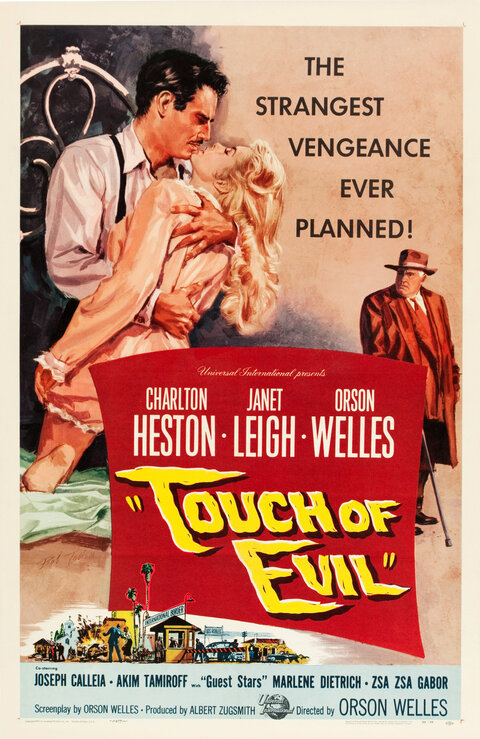
Poster: Public domain, via Wikimedia Commons.
Touch of Evil · 1958 · Film Noir
- Directed by:
- Orson Welles
- Starring:
- Marlene Dietrich, Charlton Heston, Zsa Zsa Gabor
Orson Welles directs this noir masterpiece set along the US-Mexico border, starring Welles as a morally compromised police captain who fabricates evidence to secure convictions. The title describes the corrupting moral rot that infects lawful justice when investigators compromise their ethics.
Domains
- Exam level
- CambridgeCambridgeCambridge English QualificationsThe exam suite from Cambridge University Press & Assessment, from A1 Movers up to C2 Proficiency. The benchmark names double as CEFR labels.B2 FirstIELTSIELTSInternational English Language Testing SystemThe 0–9 band test co-owned by the British Council, IDP, and Cambridge. Used for university entry, work, and migration.5.5–6.5TOEFL iBTTOEFL iBTTest of English as a Foreign Language, Internet-Based TestETS's academic English test, the standard route for US university admissions. Scored 0–120, with a 1–6 scale since 2026.1–6 scale: 4.0–4.572–94TOEICTOEICTest of English for International CommunicationETS's workplace English test, big in Japan and Korea. Listening & Reading scores 10–990 and tops out at C1.785–944
- Frequency
- Common
- Level
- B2 · Upper IntermediateOxford
- Updated
- アルファベット
- 読み方の一覧 →
QR code
englishreference.com/q/evil
※ 機械で選んだ訳語です。ネイティブスピーカーによる確認はまだです。
「日本語」 data: JMdict (EDRDG), CC BY-SA 4.0