Word
peek
US/ˈpik/
UK/pˈiːk/
Definitions
01to look secretly
B1 · Intermediate Informal
v. to look at something quickly and secretly, especially when you are not supposed to.
v. to look surreptitiously or slyly, often through a small opening or from a concealed position.
“The children tried to peek through the keyhole to see their presents.”
“She couldn't resist the urge to peek at the final chapter of the novel while she was only halfway through the book.”
Pitfall
He took a peak at the gift.
He took a peek at the gift.
Do not confuse 'peek' (a look) with 'peak' (the top of a mountain).
02to be partially visible
B2 · Upper Intermediate Informal
v. to be just barely visible, like something coming out from behind a cloud.
v. to be only partially or slightly visible, as if emerging from a hiding place or cover.
“The sun began to peek through the clouds after the heavy rain.”
“A few bright green shoots were starting to peek through the melting snow, signalling the arrival of early spring.”
03to read memory
C2 · Proficiency Computing Technical · Archaic
v. to look at a specific piece of information stored in a computer's memory.
v. to retrieve a value from a specific memory address, common in early programming languages like BASIC.
“The programmer used a command to peek at the data in that memory slot.”
“In legacy systems, developers would frequently peek and poke memory addresses to manipulate hardware registers directly.”
Synonyms
Antonyms
04a quick look
B1 · Intermediate Countable noun Informal
n. a quick or secret look at something.
n. a brief or surreptitious glance.
“Take a peek inside the box and tell me what you see.”
“The curator allowed us a sneak peek of the new exhibit before it officially opened to the general public.”
Etymology
From Middle English *peken, piken, pyken (“to peep”), probably a fusion of Middle English pepen (“to peep”) and keken, kiken (“to keek, look, spy”), equivalent to a blend of peep + keek. Perhaps also possibly a metathetic alteration of Middle English kepen, kipen, kypen (“to keep, look, observe, watch”).
Etymology adapted from Wiktionary, available under CC BY-SA 4.0.
In Music
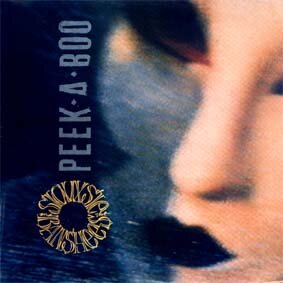
Cover shown under fair use for identification and commentary.
Peek-a-Boo · 1988 · Alternative rock
- Artist:
- Siouxsie and the Banshees
- Album:
- Peepshow
Released in July 1988 as the first single from the album Peepshow, this alternative-rock hit by Siouxsie and the Banshees reached number 16 in the UK. The title uses peek literally for a quick and secret look from a hiding place.
Domain
- Exam level
- CambridgeCambridgeCambridge English QualificationsThe exam suite from Cambridge University Press & Assessment, from A1 Movers up to C2 Proficiency. The benchmark names double as CEFR labels.B1 PreliminaryIELTSIELTSInternational English Language Testing SystemThe 0–9 band test co-owned by the British Council, IDP, and Cambridge. Used for university entry, work, and migration.4.0–5.0TOEFL iBTTOEFL iBTTest of English as a Foreign Language, Internet-Based TestETS's academic English test, the standard route for US university admissions. Scored 0–120, with a 1–6 scale since 2026.1–6 scale: 3.0–3.544–71TOEICTOEICTest of English for International CommunicationETS's workplace English test, big in Japan and Korea. Listening & Reading scores 10–990 and tops out at C1.550–784
- Frequency
- Frequent
- Level
- B1 · Intermediate
- Updated
- アルファベット
- 読み方の一覧 →
QR code
englishreference.com/q/peek