Forms
Infinitive
ride
Past
rode
Past participle
ridden
Definitions
01horse or bicycle
A1 · Beginner
v. to sit on and control a horse, bicycle, or motorcycle.
v. to sit on and control the movement of an animal or a two-wheeled vehicle. Ambitransitive use.
“She learned to ride a bike when she was only five years old.”
“The scouts spent the afternoon riding their horses through the narrow mountain passes before setting up camp.”
Antonyms
02passenger in a vehicle
A2 · Elementary
v. to travel as a passenger in a car, bus, or train.
v. to be transported in a vehicle as a passenger. Often used with 'in' or 'on'.
“I usually ride the bus to work because parking is too expensive.”
“During the transit strike, thousands of commuters had to find alternative ways to ride into the city center.”
03to depend on
B2 · Upper Intermediate
v. to depend or rely on something for success.
v. to depend or rely on a specific factor or outcome. Usually followed by 'on' or 'upon'.
“A lot of hopes are riding on the success of this new project.”
“The company's entire future was riding on the outcome of the merger negotiations, leaving the staff in a state of high anxiety.”
04to criticize or nag
C1 · Advanced Informal
v. to annoy someone by constantly criticizing them or telling them what to do.
v. to harass, nag, or criticize someone persistently. Transitive; informal in register.
“My boss has been riding me all week about that report.”
“The coach continued to ride the players throughout the practice, hoping the pressure would improve their performance before the finals.”
Antonyms
05clothing moving up
B2 · Upper Intermediate
v. when a piece of clothing moves up your body and becomes uncomfortable.
v. of a garment: to move upward out of its proper position while being worn. Often used with the particle 'up'.
“This skirt is too tight and keeps riding up when I walk.”
“He found the cheap suit uncomfortable, as the jacket sleeves tended to ride up whenever he reached for his briefcase.”
06a trip or journey
A2 · Elementary Countable noun
n. a journey made on a horse, bike, or in a vehicle.
n. an instance of being carried in a vehicle or on an animal.
“It is a long bus ride from the airport to the hotel.”
“The scenic train ride through the Alps offered breathtaking views that justified the high cost of the ticket.”
07a free lift
A2 · Elementary Countable noun
n. a free trip in someone else's car.
n. a journey given to a person in another's vehicle, typically without charge.
“Can you give me a ride to the station tomorrow morning?”
“After his car broke down, he had to ask his neighbor for a ride to the grocery store every Saturday.”
Synonyms
08amusement park machine
A2 · Elementary Countable noun
n. a large machine at a fair, like a roller coaster, that people sit on for fun.
n. a mechanical device or structure at an amusement park or fair designed for entertainment.
Español:atracción
“The children wanted to go on the water ride at the theme park.”
“The park's newest ride features a vertical drop that attracts thrill-seekers from across the country.”
Synonyms
09a vehicle
B2 · Upper Intermediate Countable noun Informal · American English
n. a person's car or other vehicle.
n. a person's motor vehicle. Informal register; common in American English.
“That is a very cool ride you have parked in the driveway.”
“He spent most of his weekends cleaning and polishing his ride to ensure it looked perfect for the local car show.”
10an attractive person
C1 · Advanced Countable noun Informal · Dialect · Slang
n. a person who is very good-looking.
n. a person perceived as sexually attractive. Dialectal usage specific to Ireland.
“Everyone in the pub thought the new barman was a total ride.”
“In local slang, she was described as a ride, though the term is rarely used in formal Irish contexts.”
11a wild experience
B2 · Upper Intermediate Countable noun
n. a long and exciting or difficult experience.
n. a period of time characterized by intense, fluctuating, or challenging experiences. Figurative use.
“The last four years in this job have been quite a ride.”
“The startup's journey from a garage to a multi-million dollar exit was a wild ride for everyone involved.”
Synonyms
Etymology
From Middle English riden, from Old English rīdan, from Proto-West Germanic rīdan, from Proto-Germanic rīdaną (“to ride”), from Proto-Indo-European Hreydʰ- (“to ride”), from h₃reyH- (“to move”), from *h₃er- (“to move, stir”). Cognates From Proto-Germanic: North Frisian ride, ridj, rir (“to ride”), West Frisian ride (“to ride”), Dutch rijden, ryden (“to ride; to drive”), German reiten, reuten (“to ride”), German Low German rieden (“to ride; to drive”), Limburgish rieje (“to ride; to drive”), Luxembourgish reiden (“to ride”), Vilamovian raeita, rajta (“to ride”), Danish ride (“to ride”), Faroese and Icelandic ríða (“to ride”), Norwegian Bokmål ri, ride (“to ride”), Norwegian Nynorsk ri, rida, ride (“to ride”), Swedish rida (“to ride”). From Indo-European: Cornish ardh (“height”), Irish arad, ard, árd (“high, tall”), Manx ard (“high, tall”), Scottish Gaelic àrd (“high”), Welsh ardd (“hill, upland”), Latin irrītō (“to excite, incite, stimulate; to exasperate”), Ancient Greek ὀρῑ́νω (orī́nō, “to move, stir”), Albanian rashë (“to have fallen; to have flopped”), Russian ре́ять (réjatʹ, “to fly, hover, soar”), Armenian հառնել (haṙnel, “to get up; to rise up”), Northern Kurdish rîtin (“to shit”), Persian ریدن (ridan, “to shit; to fuck up, to screw up”), Tocharian A ar- (“to evoke; to produce, yield”), Tocharian B er- (“to evoke; to produce, yield”), Hittite 𒅈𒉡𒊻𒍣 (ar-nu-uz-zi, “to address, send”), Sanskrit रीति (rīti, “course, motion; current, stream; line, row”).
Etymology adapted from Wiktionary, available under CC BY-SA 4.0.
Word family
VERB
NOUN
Idioms
01. free ride
02. full ride
05. ridden hard and put away wet
06. ride down
07. ride hard and put away wet
08. ride herd on
09. ride high
Show all 30
11. ride on a rail
14. ride one's luck
15. ride out
17. ride shotgun
20. ride the crest of the wave
21. ride the pine
22. ride the rails
24. ride the tiger
25. ride the wave
27. take for a ride
28. take the ride
29. thumb a ride
30. ticket to ride
The word in film
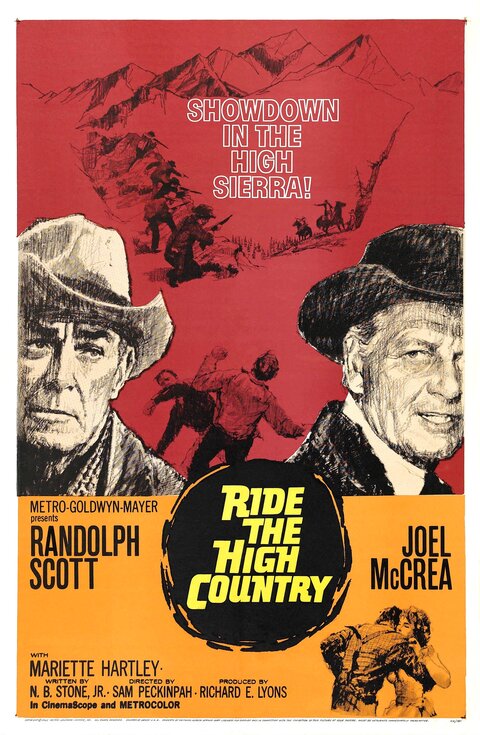
Poster: Public domain, via Wikimedia Commons.
Ride the High Country · 1962 · Western
- Directed by:
- Sam Peckinpah
- Starring:
- Randolph Scott, Joel McCrea, Mariette Hartley
Sam Peckinpah directs this celebrated Western starring screen legends Randolph Scott and Joel McCrea as two aging lawmen hired to escort gold through the Sierra Nevada. The title evokes their final journey on horseback across rugged mountain trails, framing the physical transit as a transition between eras.
Domains
- Exam level
- CambridgeCambridgeCambridge English QualificationsThe exam suite from Cambridge University Press & Assessment, from A1 Movers up to C2 Proficiency. The benchmark names double as CEFR labels.A2 KeyIELTSIELTSInternational English Language Testing SystemThe 0–9 band test co-owned by the British Council, IDP, and Cambridge. Used for university entry, work, and migration.3.0–4.0TOEFL iBTTOEFL iBTTest of English as a Foreign Language, Internet-Based TestETS's academic English test, the standard route for US university admissions. Scored 0–120, with a 1–6 scale since 2026.1–6 scale: 2.0–2.524–43TOEICTOEICTest of English for International CommunicationETS's workplace English test, big in Japan and Korea. Listening & Reading scores 10–990 and tops out at C1.225–549
- Frequency
- Very common
- Level
- A2 · ElementaryOxford
- Updated
- アルファベット
- 読み方の一覧 →
QR code
englishreference.com/q/ride
「カタカナ語」 data: JMdict (EDRDG), CC BY-SA 4.0
Traducciones: Kaikki.org (Wiktionary), CC BY-SA 4.0