Word
sea
US/ˈsi/
UK/sˈiː/
Definitions
01the ocean
A1 · Beginner Countable noun
n. the large body of salt water that covers most of the Earth.
n. the expanse of salt water that covers most of the Earth's surface and surrounds its landmasses.
日本語:海※
“The children spent the whole afternoon swimming in the sea.”
“The fishing fleet returned to the harbour just as the sea began to turn a deep, stormy grey under the gathering clouds.”
Usage
Often used with the definite article 'the'.
Pitfall
We went to the sea last weekend.
We went to the seaside last weekend.
Use 'the sea' for the water itself, but use 'the seaside' or 'the coast' when talking about going to a holiday destination by the water.
02a large amount
B2 · Upper Intermediate Countable noun
n. a very large number or amount of something that looks like it has no end.
n. a vast or overwhelming quantity of something, used figuratively to suggest immense scale or movement.
日本語:海※
“Looking out from the stage, the singer saw a sea of happy faces.”
“The protesters formed a sea of umbrellas in the square, shielding themselves from the relentless autumn rain while they waited for the announcement.”
Usage
Usually follows the pattern 'a sea of [noun]'.
03rough water or waves
B2 · Upper Intermediate Plural noun
n. the movement of the water, especially when it is rough or has big waves.
n. the state of the water's surface in terms of waves and swell, often used in the plural to describe rough conditions.
“The small boat struggled to stay upright in the heavy seas.”
“The captain decided to change course to avoid the high seas reported by the weather station further north.”
Usage
Often used in the plural ('heavy seas') to describe weather conditions.
Antonyms
04lunar plain
C2 · Proficiency Countable noun Science Technical
n. a large, dark, flat area on the surface of the moon.
n. a large, dark basaltic plain on Earth's Moon, historically mistaken for a body of water.
“The Sea of Tranquility is the most famous dark plain on the moon.”
“Early astronomers named these vast basaltic plains 'seas' under the mistaken belief that they were filled with water rather than volcanic rock.”
Usage
Often translated from the Latin 'mare'.
Teaching tip
This is a specialized term used in astronomy; students will mostly encounter it in textbooks about space.
Synonyms
05particle physics
C2 · Proficiency Countable noun Science Technical
n. a group of particles that constantly appear and disappear inside an atom.
n. a theoretical model of the vacuum or the interior of a hadron consisting of a constant flux of virtual particles.
“Scientists study the sea of quarks to understand how atoms work.”
“The distribution of momentum among the sea quarks provides crucial data for high-energy collision experiments in particle accelerators.”
Usage
Used specifically in quantum field theory and particle physics.
Synonyms
Collocations
Common phrases and expressions where native English speakers use the word “sea” in context.
Real-World Examples
“The injection of thermal energy, 40 times that used by humanity in total, comes amid an increasing rise in sea levels and continuing acidification” “A record-breaking 23 zettajoules of heat was sunk into the world’s seas last year, leaving ocean waters hotter, higher and less hospitable, a report has found.” “Rising sea destroys homes, erases beaches in California.” Etymology
Inherited from Middle English see, from Old English sǣ, from Proto-West Germanic saiwi (“body of water”), from Proto-Germanic saiwiz, itself either: Derived from Proto-Indo-European sh₂ey-wo- (“to be fierce, afflict”). Related to Latin saevus (“wild, fierce”), Tocharian B saiwe (“itch”), and Latvian sievs, sīvs (“sharp, biting”). More at sore. Derived from Proto-Germanic sīhwaną (“to percolate, filter”), from Proto-Indo-European *seykʷ-. Cognates Cognate with Yola zea, zee (“sea”), North Frisian See, sia, siie (“sea; lake”), Saterland Frisian See, Säi (“sea”), West Frisian see (“sea”), Cimbrian, Mòcheno sea (“lake”), Dutch zee (“sea”), German, German Low German See (“sea”), Limburgish Sië, zieë (“sea, ocean; lake”), Luxembourgish Séi (“lake”), West Flemish zji (“sea; seaside”), Danish sø (“sea; lake”), Faroese sjógvur (“sea; big wave”), Icelandic sjár, sjór, sær (“sea”), Norwegian Bokmål, Norwegian Nynorsk sjø (“sea, ocean; lake”), Swedish sjö (“sea; lake; big wave”), Gothic 𐍃𐌰𐌹𐍅𐍃 (saiws, “lake, sea; marshland”).
Etymology adapted from Wiktionary, available under CC BY-SA 4.0.
Related words
Idioms
01. drop in the sea
02. go to sea
04. people mountain people sea
06. sail the Red Sea
07. sea change
08. sea legs
09. sea load
10. two lamps burning and no ship at sea
Show all 11
11. victory at sea
In Literature
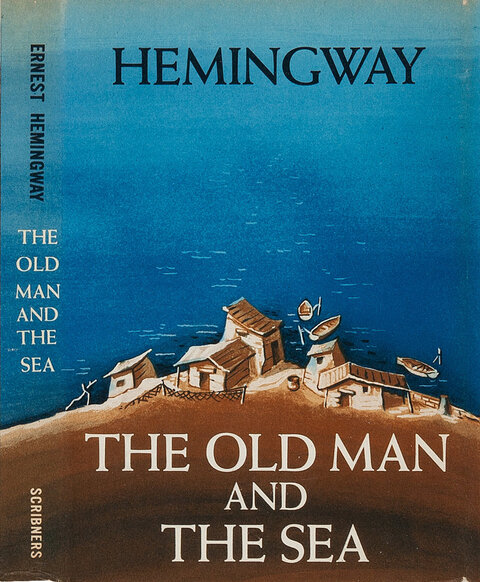
Cover: Public domain, via Wikimedia Commons — “Jacket design by A.” Author's photograph by Lee Samuels.
The Old Man and the Sea · 1952-09-01 · Literary novella
- Author:
- Ernest Hemingway
Ernest Hemingway's classic novella follows Santiago, an aging Cuban fisherman who has gone eighty-four days without a catch. The story focuses on his solitary, grueling battle against a giant marlin in the deep waters of the Gulf Stream. Through this struggle, the vast and unpredictable nature of the open water becomes a testing ground for the old man's endurance and spirit.
Domains
- Exam level
- CambridgeCambridgeCambridge English QualificationsThe exam suite from Cambridge University Press & Assessment, from A1 Movers up to C2 Proficiency. The benchmark names double as CEFR labels.A1 MoversIELTSIELTSInternational English Language Testing SystemThe 0–9 band test co-owned by the British Council, IDP, and Cambridge. Used for university entry, work, and migration.2.0–3.0TOEFL iBTTOEFL iBTTest of English as a Foreign Language, Internet-Based TestETS's academic English test, the standard route for US university admissions. Scored 0–120, with a 1–6 scale since 2026.1–6 scale: 1.0–1.50–23TOEICTOEICTest of English for International CommunicationETS's workplace English test, big in Japan and Korea. Listening & Reading scores 10–990 and tops out at C1.120–224
- Frequency
- Very common
- Level
- A1 · BeginnerOxford
- Updated
- アルファベット
- 読み方の一覧 →
QR code
englishreference.com/q/sea
※ 機械で選んだ訳語です。ネイティブスピーカーによる確認はまだです。
「日本語」 data: JMdict (EDRDG), CC BY-SA 4.0