Word
tale
US/ˈteɪɫ/
UK/tˈeɪl/
Definitions
01a story
B1 · Intermediate Countable noun
n. a story about exciting, imaginary, or historical events.
n. a narrative of events, especially one that is imaginatively recounted or legendary in nature.
日本語:物語※
“My grandfather used to tell us a tall tale about a giant fish he once caught.”
“The explorer's journals were filled with many a wondrous tale of lost cities and mythical creatures hidden deep within the jungle.”
02gossip or a lie
B2 · Upper Intermediate Countable noun
n. a report or piece of gossip that is often untrue or shared to cause trouble.
n. an account of asserted facts or circumstances, often implying a malicious rumour, a lie, or idle gossip.
“Don't listen to him; he is just telling tales to make his coworkers look bad.”
“The witness was accused of spinning a tale to protect his associates from legal repercussions during the cross-examination.”
03a total count
C2 · Proficiency Countable noun Archaic
n. a total number of things that have been counted.
n. a reckoning by count; a total number or enumeration of items.
“The workers had to deliver the full tale of bricks by the end of the day.”
“The ancient ledger recorded the exact tale of sheep brought to market each spring for over a century.”
04a scam
C2 · Proficiency Countable noun Law Slang · Technical
n. a trick or fake story used by a criminal to cheat someone out of money.
n. the fraudulent narrative or opportunity presented by a confidence artist to a victim.
“The police warned the public about a new tale involving fake lottery winnings.”
“The investigator noted that the suspect used a sophisticated tale to convince the investors that their capital was being used for offshore developments.”
Collocations
Common phrases and expressions where native English speakers use the word “tale” in context.
Verb
01. spin a tale
“The witness began to spin a tale that sounded far too convenient for the police.”
verb + noun
02. tell a tale
“My grandfather used to tell a tale about his adventures at sea.”
verb + noun
Adjective
03. cautionary tale
“The documentary serves as a cautionary tale for young investors.”
adj + noun
04. gripping tale
“The novel is a gripping tale of survival in the Amazon rainforest.”
adj + noun
05. tall tale
“Nobody believed his tall tale about catching a fish the size of a car.”
adj + noun
Noun
06. fairy tale
“The children listened intently as the teacher read a classic fairy tale.”
noun + noun
07. tale of woe
“She sat down and shared a long tale of woe regarding her recent financial troubles.”
noun + of + noun
Real-World Examples
“In the dog days of the second world war, 24-year-old Maurice Schérer wrote a tale of young lovers in prewar small-town France.” “Each storyteller can’t help but bend the tale to their will.” “The Cowherd and the Weaver Girl," a classic Chinese narrative from the first millennium B.C., tells the tale of a couple who challenge societal norms to marry for love.” “Most of the viewers spun elaborate tales involving lovers, violence and abandonment.” Etymology
From Middle English tale, from Old English talu (“tale, series, calculation”), from Proto-West Germanic talu, from Proto-Germanic talō (“calculation, number”), from Proto-Indo-European *del- (“to reckon, count”). Cognate with West Frisian taal (“speech, language”), Dutch taal (“language, speech”), German Zahl (“number, figure”), Danish tale (“speech”), Icelandic tala (“speech, talk, discourse, number, figure”), Latin dolus (“guile, deceit, fraud”), Ancient Greek δόλος (dólos, “wile, bait”), Albanian ndjell (“to lure”), Northern Kurdish til (“finger”), Old Armenian տող (toł, “row”). Related to tell, talk.
From Middle English talen, from Old English talian (“to count, calculate, reckon”), from Proto-West Germanic talōn, from Proto-Germanic talōną (“to count”), from Proto-Indo-European *del- (“to count, reckon, aim, calculate, adjust”). Cognate with Dutch talen (“to long, care”), German zahlen (“to pay”), Swedish tala (“to speak, talk”), Icelandic tala (“to talk”).
Etymology adapted from Wiktionary, available under CC BY-SA 4.0.
Word family
NOUN
Idioms
In Literature
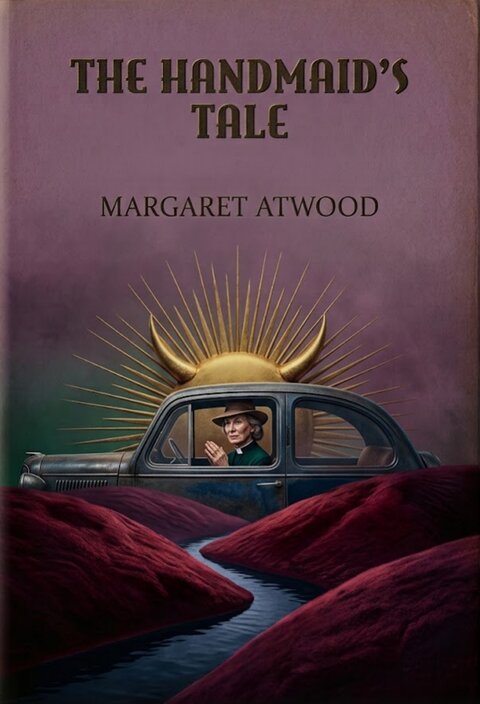
Original artwork created for englishreference.com.
The Handmaid's Tale · 1985-08-01 · Dystopian fiction, feminist science fiction
- Author:
- Margaret Atwood
Margaret Atwood's 1985 dystopian novel follows a woman named Offred living under a totalitarian regime where she is forced into reproductive servitude. The title uses the word to frame her personal account as a historical record of her life and struggles in the Republic of Gilead. By calling it a 'tale,' the author emphasizes the protagonist's role as a storyteller sharing her private experiences in a restricted society.
Domain
- Exam level
- CambridgeCambridgeCambridge English QualificationsThe exam suite from Cambridge University Press & Assessment, from A1 Movers up to C2 Proficiency. The benchmark names double as CEFR labels.B2 FirstIELTSIELTSInternational English Language Testing SystemThe 0–9 band test co-owned by the British Council, IDP, and Cambridge. Used for university entry, work, and migration.5.5–6.5TOEFL iBTTOEFL iBTTest of English as a Foreign Language, Internet-Based TestETS's academic English test, the standard route for US university admissions. Scored 0–120, with a 1–6 scale since 2026.1–6 scale: 4.0–4.572–94TOEICTOEICTest of English for International CommunicationETS's workplace English test, big in Japan and Korea. Listening & Reading scores 10–990 and tops out at C1.785–944
- Frequency
- Common
- Level
- B2 · Upper IntermediateOxford
- Updated
- アルファベット
- 読み方の一覧 →
QR code
englishreference.com/q/tale
※ 機械で選んだ訳語です。ネイティブスピーカーによる確認はまだです。
「日本語」 data: JMdict (EDRDG), CC BY-SA 4.0