Word
waste
US/ˈweɪst/
UK/wˈeɪst/
Definitions
01trash or garbage
B1 · Intermediate Uncountable noun
n. materials that are no longer needed and are thrown away.
n. useless by-products or damaged materials discarded as no longer functional or saleable.
日本語:無駄(にする)、ごみ※
“The city has a new system for collecting household waste every Tuesday.”
“Industrial waste must be processed according to strict environmental regulations to prevent toxic runoff into the local water table.”
02bad use of something
B1 · Intermediate Countable noun
n. the act of using more of something than you need, or using it badly.
n. the act of consuming or using a resource ineffectually or extravagantly.
日本語:無駄遣い※
“Leaving the lights on all night is a total waste of electricity.”
“The auditor concluded that the project was a monumental waste of taxpayer money, citing poor management and lack of oversight.”
Synonyms
Antonyms
03bodily discharge
B2 · Upper Intermediate Uncountable noun Medicine Technical
n. the materials that your body gets rid of, like urine.
n. excrement or urine produced by a living organism.
日本語:汚物※
“The doctor asked for a sample to check for chemicals in his body waste.”
“The facility was designed to treat human waste safely before discharging the purified water back into the river.”
Synonyms
04to use poorly
B1 · Intermediate
v. to use money, time, or energy on things that are not useful.
v. to squander or dissipate resources uselessly; often used with time, money, or effort.
“I don't want to waste my weekend watching boring movies.”
“The company cannot afford to waste its marketing budget on campaigns that do not reach the target demographic.”
Pitfall
Don't waste your time to do that.
Don't waste your time doing that.
The verb 'waste' is followed by a gerund (-ing form), not an infinitive.
Synonyms
05to become weak
C1 · Advanced Medicine Formal
v. to become thin and weak, usually because of a serious illness.
v. to lose weight, strength, or vitality gradually, typically due to disease or lack of nutrition.
“Without proper food, the animals began to waste away.”
“The patient continued to waste away despite the aggressive nutritional therapy provided by the hospital staff.”
Usage
Often used with the particle 'away'.
06to kill
C1 · Advanced Slang
v. to kill someone.
v. to murder or assassinate someone.
“In the movie, the villain threatened to waste anyone who got in his way.”
“The dialogue in the crime thriller was filled with threats to waste rivals who interfered with the gang's operations.”
07useless or extra
B2 · Upper Intermediate
adj. describing something that is extra and not needed, or rejected as bad.
adj. superfluous, rejected as defective, or produced in excess of requirements.
“The factory sells its waste paper to a recycling company.”
“The pipe was designed to carry waste steam away from the main engine to prevent pressure buildup.”
Synonyms
Antonyms
Collocations
Common phrases and expressions where native English speakers use the word “waste” in context.
Noun
01. waste product
“Carbon dioxide is a waste product that we breathe out from our lungs.”
noun + noun
02. waste of my time
03. waste heat
Real-World Examples
“Human waste in the form of plastics and other objects is everywhere in the deep ocean, a fact that is made brutally apparent by the Japan Agency for Marine-Earth Science and Technology’s Deep-sea Debris Database, which documents the presence of tyres, fishing nets, sports bags, mannequins, beach balls and baby’s bottles spread across the sea floor at depths of many thousands of metres.” “Reduce your sanitary waste with reusable washable cloth nappies rather than disposables.” “If there’s one vital, but underappreciated, subject in the conversation about climate change, it’s waste: how to define it, how to create less of it, how to deal with it without adding more pollution to the planet or the atmosphere.” Etymology
From Middle English wast, waste (“a waste”, noun), from Anglo-Norman, Old Northern French wast, waste (“a waste”), from Frankish wōstī (“a waste”), from Proto-Germanic wōstaz, wōstuz, from Proto-Indo-European h₁weh₂- (“empty, wasted”).
From Middle English wast, waste (“waste”, adjective), from Anglo-Norman, Old Northern French wast (“waste”), from Frankish wōstī (“waste, empty”), from Proto-Indo-European h₁weh₂- (“empty, wasted”). Cognate with Old High German wuosti, wuasti (“waste, empty”), German wüst, Old Saxon wōsti (“desolate”), Old English wēste (“waste, barren, desolate, empty”).
From Middle English wasten (“to waste, lay waste”), from Anglo-Norman, Old Northern French waster (“to waste, devastate”) (compare also the variant gaster and French gâter from a related Old French word); the Anglo-Norman form waster was either from Frankish wōstijan (“to waste”), from Proto-Indo-European wāsto- (“empty, wasted”), or alternatively from Latin vastāre and influenced by the Frankish; the English word was assisted by similarity to native Middle English westen ("to waste"; > English weest). Cognate with Old High German wuostan, wuastan, wuostjan (“to waste”) (Modern German wüsten), Old English wēstan (“to lay waste, ravage”). Displaced native Old English essian and strȳndan. Largely overtook Old English forspillan and wēstan.
Etymology adapted from Wiktionary, available under CC BY-SA 4.0.
Word family
VERB
NOUN
Related words
Idioms
In Literature
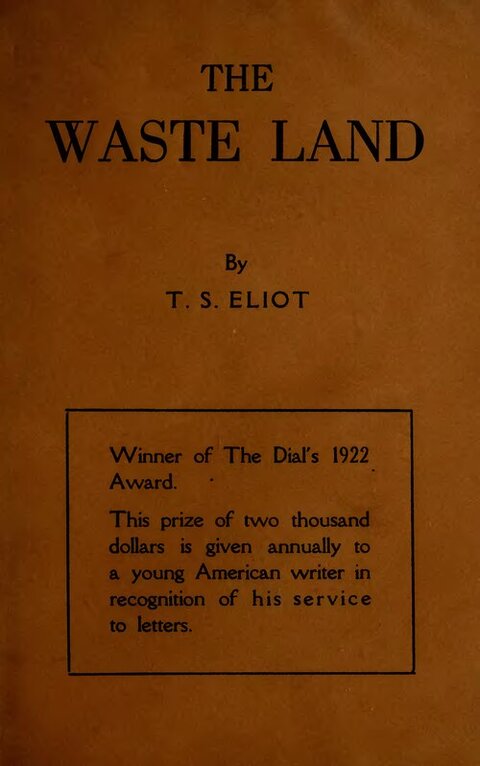
Cover: First edition cover, via Wikimedia Commons.
The Waste Land · 1922-01-01 · Poetry
- Author:
- T. S. Eliot
T. S. Eliot’s 1922 masterpiece portrays a fractured, post-war society that feels spiritually empty and exhausted. The title uses the word to describe a barren landscape where nothing can grow, reflecting the characters' sense of psychological and cultural desolation. Through various voices and settings, the poem explores a world that has become useless and broken.
Domains
- Exam level
- CambridgeCambridgeCambridge English QualificationsThe exam suite from Cambridge University Press & Assessment, from A1 Movers up to C2 Proficiency. The benchmark names double as CEFR labels.B1 PreliminaryIELTSIELTSInternational English Language Testing SystemThe 0–9 band test co-owned by the British Council, IDP, and Cambridge. Used for university entry, work, and migration.4.0–5.0TOEFL iBTTOEFL iBTTest of English as a Foreign Language, Internet-Based TestETS's academic English test, the standard route for US university admissions. Scored 0–120, with a 1–6 scale since 2026.1–6 scale: 3.0–3.544–71TOEICTOEICTest of English for International CommunicationETS's workplace English test, big in Japan and Korea. Listening & Reading scores 10–990 and tops out at C1.550–784
- Frequency
- Very common
- Level
- B1 · IntermediateOxford
- Updated
- アルファベット
- 読み方の一覧 →
QR code
englishreference.com/q/waste
※ 機械で選んだ訳語です。ネイティブスピーカーによる確認はまだです。
「日本語」 data: JMdict (EDRDG), CC BY-SA 4.0