Word
delicate
Phoneticsdel·i·cate, stress on the first syllable
US/ˈdɛɫəkət/
UK/dˈɛlɪkət/
Definitions
01easily broken
B1 · Intermediate
adj. easily damaged or broken; needing very careful handling.
adj. physically fragile or easily damaged; requiring cautious manipulation to avoid breakage.
日本語:デリケート※
Español:delicado
“Be careful with those delicate wine glasses when you wash them.”
“The restoration of the delicate silk tapestry required months of painstaking work by a team of textile specialists.”
Synonyms
02fine or detailed
B2 · Upper Intermediate
adj. having a very thin, light, or detailed structure.
adj. characterized by a fine, intricate, or subtle structure; often used of patterns, features, or craftsmanship.
日本語:繊細※
“The spider web was covered in delicate drops of morning dew.”
“The watchmaker used specialized tools to adjust the delicate internal gears of the antique chronometer.”
03requiring tact
B2 · Upper Intermediate
adj. needing careful treatment because it could easily cause trouble or offense.
adj. requiring great tact, diplomacy, or sensitivity to manage successfully without causing conflict.
日本語:デリケート※
“The manager had to handle a delicate situation between two angry employees.”
“The diplomat navigated the delicate negotiations with skill, ensuring that neither party felt their sovereignty was being challenged.”
Antonyms
04subtle or light
B2 · Upper Intermediate
adj. pleasant and not strong, such as a light smell, taste, or color.
adj. subtle or understated in sensory quality; not intense or overpowering.
“The soup had a delicate flavor of fresh herbs and lemon.”
“The artist chose a delicate shade of pink for the sky to suggest the very first moments of dawn.”
05weak health
C1 · Advanced Medicine Formal
adj. having a body that is not strong and gets sick easily.
adj. possessing a fragile constitution; prone to illness or physical exhaustion.
“The child had always been in delicate health since he was born.”
“Despite her delicate constitution, she insisted on traveling across the continent to attend the scientific symposium.”
06hungover
C2 · Proficiency British English · Informal · Humorous
adj. feeling slightly sick or sensitive, especially after drinking too much alcohol.
adj. feeling physically sensitive or unwell, typically as a result of a hangover.
“I'm feeling a bit delicate this morning after the office party.”
“He was feeling rather delicate after the wedding celebrations and spent the entire Sunday morning in a darkened room.”
Teaching tip
This is a common British euphemism for a hangover; it implies the person needs quiet and gentle treatment.
07fragile clothing
B2 · Upper Intermediate Plural noun
n. clothes that are made of thin or expensive material and need a gentle wash.
n. items of clothing, such as lingerie or silk garments, that require a gentle laundry cycle.
“You should wash your delicates in a separate mesh bag.”
“The modern washing machine features a specific cycle designed to protect delicates from being stretched or torn during the spin.”
Usage
Usually used in the plural form.
Synonyms
Collocations
Common phrases and expressions where native English speakers use the word “delicate” in context.
Verb
01. handle the delicate situation
“The diplomat had to handle the delicate situation with extreme tact to avoid an international incident.”
verb + adj + noun
02. strike a delicate balance
“The architect managed to strike a delicate balance between modern aesthetics and historical preservation.”
verb + adj + noun
Adjective
03. delicate lace pattern
“The wedding dress was adorned with a delicate lace pattern that had been hand-stitched.”
adj + noun
04. delicate to handle
“These antique glass ornaments are incredibly delicate to handle and require special packaging.”
adj + infinitive
05. extremely delicate
“The ecosystem in the coral reef is extremely delicate and easily disrupted by rising sea temperatures.”
adv + adj
Noun
06. delicate matter of ethics
“The committee met in private to discuss a delicate matter of ethics regarding the new research data.”
adj + noun
07. delicate state of health
“Given his delicate state of health, the doctors advised against any strenuous physical activity.”
adj + noun
Real-World Examples
“Finding fossils from much earlier periods requires searching in places where delicate biological material had an unusual chance of surviving.” “Spider webs are often made with multiple types of silk: a stronger form that creates a structure, and a more delicate, sticky form that traps prey.” “One scene shows him arguing with his employer, who is angry that the boy fumbled a delicate task during one of the minor earthquakes that preceded the disaster.” Etymology
From Middle English delicat, from Latin dēlicātus (“giving pleasure, delightful, soft, luxurious, delicate, (in Medieval Latin also) fine, slender”), from dēlicia + -ātus (see -ate (adjective-forming suffix)), usually in plural dēliciae (“pleasure, delight, luxury”), from dēliciō (“to allure, entice”), from dē- (“away”) + laciō (“to lure, to deceive”), from Proto-Italic *lakjō (“to draw, pull”), of unknown ultimate origin. Compare delight, delicious and Spanish delgado (“thin, skinny”). The noun is from a substantivization of the adjective (see -ate).
Etymology adapted from Wiktionary, available under CC BY-SA 4.0.
Word family
ADJECTIVE
ADVERB
Related words
In Music
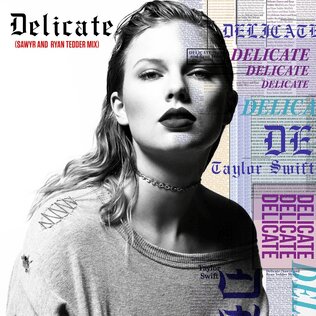
Cover shown under fair use for identification and commentary.
Delicate · 2018 · Pop music
- Artist:
- Taylor Swift
- Album:
- Reputation
Taylor Swift explores the anxiety of a new romance in this 2018 synth-pop ballad. The title refers to the fragile nature of a relationship that could easily be ruined by public attention, using the word to describe a situation that requires extremely careful handling.
- Exam level
- CambridgeCambridgeCambridge English QualificationsThe exam suite from Cambridge University Press & Assessment, from A1 Movers up to C2 Proficiency. The benchmark names double as CEFR labels.C1 AdvancedIELTSIELTSInternational English Language Testing SystemThe 0–9 band test co-owned by the British Council, IDP, and Cambridge. Used for university entry, work, and migration.7.0–8.0TOEFL iBTTOEFL iBTTest of English as a Foreign Language, Internet-Based TestETS's academic English test, the standard route for US university admissions. Scored 0–120, with a 1–6 scale since 2026.1–6 scale: 5.0–5.595–113TOEICTOEICTest of English for International CommunicationETS's workplace English test, big in Japan and Korea. Listening & Reading scores 10–990 and tops out at C1.945–990
- Frequency
- Common
- Level
- C1 · AdvancedOxford
- Updated
- アルファベット
- 読み方の一覧 →
QR code
englishreference.com/q/delicate
※ 機械で選んだ訳語です。ネイティブスピーカーによる確認はまだです。
「日本語」 data: JMdict (EDRDG), CC BY-SA 4.0
Traducciones: Kaikki.org (Wiktionary), CC BY-SA 4.0