Word
weak
US/ˈwik/
UK/wˈiːk/
Definitions
01lacking physical strength
A2 · Elementary
adj. not physically strong or healthy.
adj. lacking physical power, vigour, or robustness; often used to describe a person's constitution or a specific muscle group.
日本語:弱い※
“He felt weak after having the flu for a whole week.”
“The patient's pulse remained weak and thready for several hours following the surgery, requiring constant monitoring by the nursing staff.”
02easily broken
A2 · Elementary
adj. likely to break or fail under pressure.
adj. lacking structural integrity or the ability to withstand weight, pressure, or strain.
日本語:もろい※
“Don't sit on that chair; the legs are very weak.”
“The bridge was closed to heavy traffic after engineers discovered a weak point in the central supporting arch.”
03lacking power or influence
B1 · Intermediate
adj. not having much power, influence, or authority.
adj. lacking in force, authority, or the ability to command; often used of leaders, governments, or positions.
日本語:弱い※
“The king was a weak ruler who couldn't control his own army.”
“The central government was too weak to enforce the new environmental regulations across the distant provinces.”
Synonyms
Antonyms
04diluted or thin
B1 · Intermediate Cooking
adj. containing a lot of water and not much flavour or strength.
adj. lacking in normal or expected potency, intensity, or flavour due to dilution.
“I prefer my tea quite weak, so please don't leave the tea bag in for long.”
“The coffee served at the conference was disappointingly weak, tasting more like tinted water than a morning stimulant.”
Antonyms
05not convincing
B2 · Upper Intermediate Law
adj. not easy to believe or not supported by good reasons.
adj. lacking the power to convince or persuade; poorly supported by evidence or logic.
“The police thought his excuse for being late was very weak.”
“The prosecution's case was considered weak because it relied almost entirely on circumstantial evidence rather than forensic proof.”
Synonyms
Antonyms
06lacking character
B2 · Upper Intermediate
adj. easily influenced by other people or unable to resist temptation.
adj. lacking in moral strength, resolution, or willpower; easily persuaded or led by others.
“He knew he shouldn't have another dessert, but he was too weak to say no.”
“Critics described the protagonist as a weak character who allowed himself to be manipulated by everyone he encountered.”
Synonyms
Antonyms
07subatomic force
C2 · Proficiency Science Technical
adj. related to one of the four basic forces in nature that causes some types of radiation.
adj. relating to the weak interaction, one of the four fundamental forces of nature, responsible for nuclear beta decay.
“Scientists study the weak force to understand how particles break apart.”
“The Standard Model of particle physics unifies the electromagnetic and weak forces into a single electroweak interaction.”
Antonyms
08bad or uncool
C1 · Advanced Slang · Informal
adj. not good, boring, or disappointing.
adj. used to describe something as inadequate, unimpressive, or socially pathetic.
“It's really weak that they cancelled the party at the last minute.”
“The crowd thought the comedian's opening set was pretty weak, as nobody laughed at his first three jokes.”
Etymology
From Middle English weyk, wayk, weik, waik, from Old Norse veikr (“weak”), from Proto-Germanic waikwaz (“weak, yielded, pliant, bendsome”), from Proto-Indo-European weyk- (“to bend, wind”). Cognate with Old English wāc (“weak, bendsome”), Saterland Frisian wook (“soft, gentle, tender”), West Frisian weak (“soft”), Dutch week (“soft, weak”), German weich (“weak, soft”), Norwegian veik (“weak”), Swedish vek (“weak, pliant”), Icelandic veikur (“bendsome, weak”). Related to Old English wīcan (“to yield”). Doublet of week and wick.
Etymology adapted from Wiktionary, available under CC BY-SA 4.0.
Word family
VERB
NOUN
ADJECTIVE
Idioms
In Music
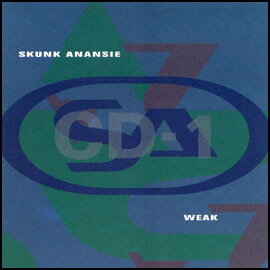
Cover shown under fair use for identification and commentary.
Weak · 1996 · Alternative rock
- Artist:
- Skunk Anansie
- Album:
- Paranoid & Sunburnt
British rock band Skunk Anansie released this alternative hit in 1996 as a powerful anthem about emotional vulnerability. The title uses the word in a figurative sense to describe someone who feels powerless and unable to resist their feelings for another person.
Domains
- Exam level
- CambridgeCambridgeCambridge English QualificationsThe exam suite from Cambridge University Press & Assessment, from A1 Movers up to C2 Proficiency. The benchmark names double as CEFR labels.A2 KeyIELTSIELTSInternational English Language Testing SystemThe 0–9 band test co-owned by the British Council, IDP, and Cambridge. Used for university entry, work, and migration.3.0–4.0TOEFL iBTTOEFL iBTTest of English as a Foreign Language, Internet-Based TestETS's academic English test, the standard route for US university admissions. Scored 0–120, with a 1–6 scale since 2026.1–6 scale: 2.0–2.524–43TOEICTOEICTest of English for International CommunicationETS's workplace English test, big in Japan and Korea. Listening & Reading scores 10–990 and tops out at C1.225–549
- Frequency
- Common
- Level
- A2 · ElementaryOxford
- Updated
- アルファベット
- 読み方の一覧 →
QR code
englishreference.com/q/weak
※ 機械で選んだ訳語です。ネイティブスピーカーによる確認はまだです。
「日本語」 data: JMdict (EDRDG), CC BY-SA 4.0