Word
happy
Phoneticshap·py, stress on the first syllable
US/ˈhæpi/
UK/hˈæpi/
Definitions
01feeling good
A1 · Beginner
adj. feeling or showing pleasure and enjoyment.
adj. experiencing or manifesting pleasure, contentment, or joy.
日本語:幸せな、うれしい※
“The children were very happy when they saw the new playground.”
“The research suggests that people who maintain strong social connections are generally more happy and resilient throughout their lives.”
Pitfall
I am very happy for your success.
I am very happy about your success.
Use 'happy for' when referring to a person, but 'happy about' when referring to a situation or event.
02willing or satisfied
B1 · Intermediate
adj. being satisfied with a choice or willing to do something.
adj. content or satisfied with a particular arrangement; willing to perform a specific action without objection.
“I am happy to help you with your homework this evening.”
“The client confirmed they were happy with the revised contract terms and were ready to sign the agreement immediately.”
Usage
Often followed by a 'to' infinitive or the preposition 'with'.
03greetings
A1 · Beginner
adj. you use this to wish someone a good time on a special day.
adj. used in conventionalized formulas to express good wishes on the occasion of a festival or anniversary.
“We all sang Happy Birthday to him when the cake arrived.”
“The department sent out a mass email wishing all staff a Happy New Year before the office closed for the holidays.”
Synonyms
04lucky or fortunate
C1 · Advanced Formal · Literary
adj. happening in a lucky or good way.
adj. characterized by good fortune or being particularly apt for a situation.
“It was a happy accident that we met at the station.”
“By a happy coincidence, the two researchers had been working on identical problems from different mathematical perspectives.”
Antonyms
Collocations
Common phrases and expressions where native English speakers use the word “happy” in context.
Word family
NOUN
ADJECTIVE
ADVERB
Related words
Idioms
The word in film
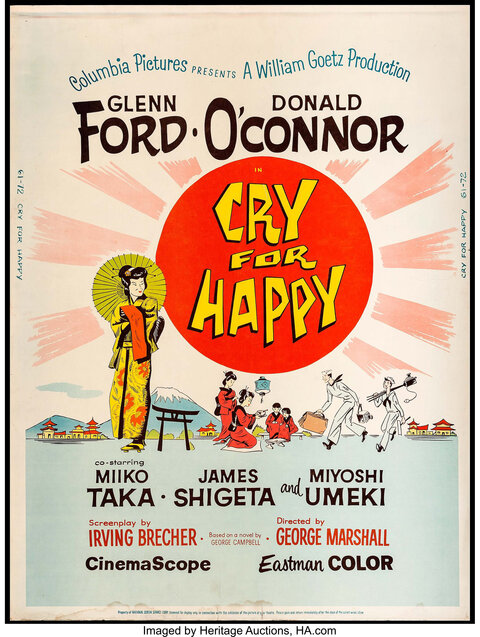
Poster: Public domain, via Wikimedia Commons.
Cry for Happy · 1961 · Comedy
- Directed by:
- George Marshall
- Starring:
- Glenn Ford, Donald O'Connor, Miiko Taka
George Marshall directs this lighthearted comedy following four American sailors who become deeply charmed by Japanese cultural traditions. The title captures the emotional state of ecstatic cheer and heartfelt relief that overwhelms the characters when mutual misunderstandings are peacefully resolved.
- Exam level
- CambridgeCambridgeCambridge English QualificationsThe exam suite from Cambridge University Press & Assessment, from A1 Movers up to C2 Proficiency. The benchmark names double as CEFR labels.A1 MoversIELTSIELTSInternational English Language Testing SystemThe 0–9 band test co-owned by the British Council, IDP, and Cambridge. Used for university entry, work, and migration.2.0–3.0TOEFL iBTTOEFL iBTTest of English as a Foreign Language, Internet-Based TestETS's academic English test, the standard route for US university admissions. Scored 0–120, with a 1–6 scale since 2026.1–6 scale: 1.0–1.50–23TOEICTOEICTest of English for International CommunicationETS's workplace English test, big in Japan and Korea. Listening & Reading scores 10–990 and tops out at C1.120–224
- Frequency
- Very common
- Level
- A1 · BeginnerOxford
- Updated
- アルファベット
- 読み方の一覧 →
QR code
englishreference.com/q/happy
※ 機械で選んだ訳語です。ネイティブスピーカーによる確認はまだです。
「日本語」 data: JMdict (EDRDG), CC BY-SA 4.0